Rediscovering Yourself After a Late Diagnosis: What Identity Looks Like on the Other Side
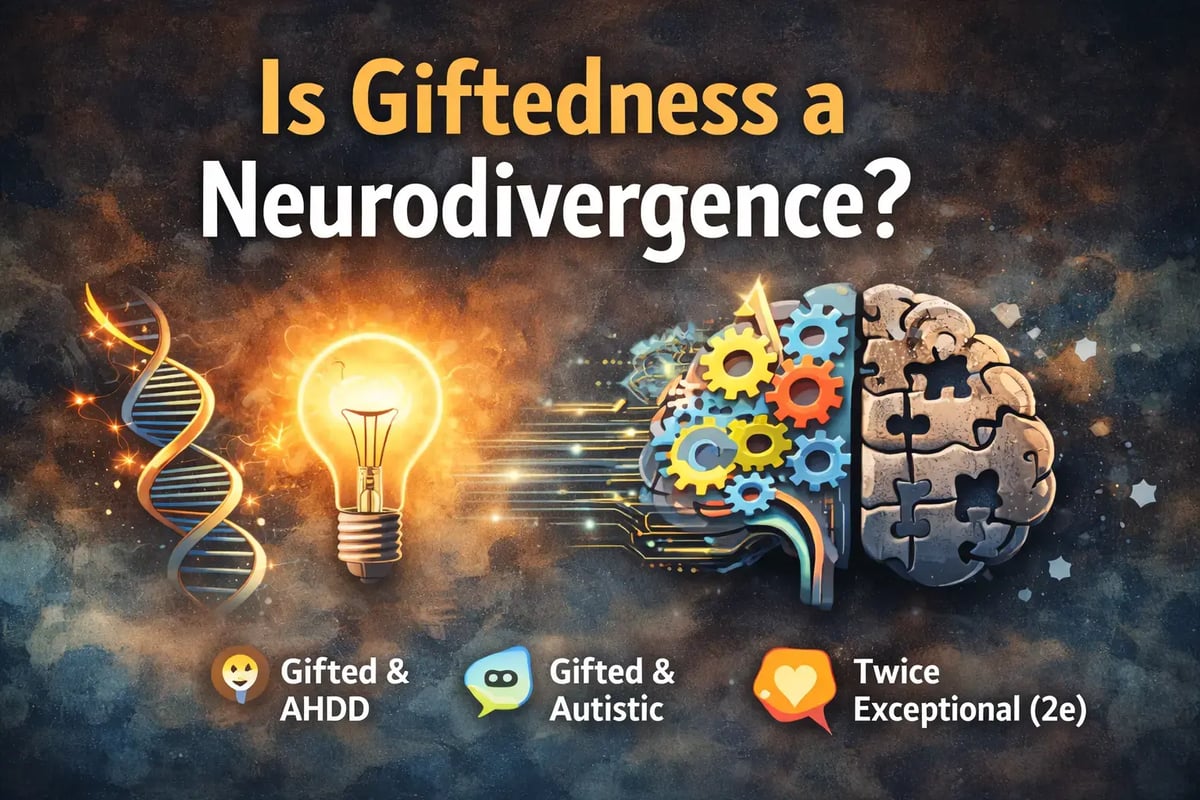
TL;DR: Is giftedness neurodivergent?
- The Verdict: Yes, giftedness is a form of neurodivergence characterized by asynchronous development and intense sensory processing.
- The 2e Connection: When giftedness coexists with ADHD or Autism, it is called Twice Exceptional (2e).
- The Challenge: High intelligence often masks struggles (Shadowing), leading to autistic burnout and chronic exhaustion in 2e adults.
Is giftedness neurodivergent? The short answer is yes; giftedness is a form of neurodivergence. It refers to a brain that develops asynchronously, meaning your cognitive abilities may be significantly advanced while your emotional or sensory processing develops at a different pace. When it is paired with a diagnosis like ADHD or Autism, it is known as being twice exceptional (2e).
In my clinical practice in Toronto and in my own life, I've seen how giftedness can act as a cloak. For years, I was able to do things most ADHDers struggle with—I had a strong working memory, decent school grades, and I was always on time.
My gifted traits made the impact of ADHD nearly invisible. But this 'external success' came at a high internal cost. I had chronic anxiety, perfectionism, and eventually, total exhaustion. This is the reality of being twice exceptional: you aren't 'fine,' you are high-performing while burning out.
So, the question is, is being twice exceptional (2e) really a gift?
Redefining High Ability. What Does Gifted Mean in 2026?
In the 2020s, we have moved past the outdated views of the 90s that gifted means "a high IQ score" and into a recognition of neurodevelopmental differences. A brain can be advanced in logic but delayed in sensory or emotional regulation—this is what we mean by "gifted".
The leading experts in neurodivergence classify giftedness as a form of neurodivergence due to high intensity and atypical processing.
Understanding the Twice Exceptional (2e) Brain
Defining 2e: The Dual Identity
Typically, 2e looks something like this:
Exceptionality 1: (Giftedness) High intellectual ability, creativity, or specific talent.
Exceptionality 2: This can include ADHD, Autism (ASD), Dyslexia, Dysgraphia, or Sensory Processing Disorder.
When a person has both types of exceptionalities, they experience the world in unique ways—often in ways that clash internally. The result is a completely different way of processing the world.
The Paradox of Ability
Traditional intelligence is viewed as a flat line, so if you are good at math, you are expected to be organized in your homework. For a 2e individual, the profile is jagged.
|
The Strength |
The Struggle |
|
Can explain the law of thermodynamics |
Cannot find their shoes or clean their room. |
|
Reads at the college level by age 7 |
Struggles to write a single coherent paragraph (Dysgraphia) |
|
Solves complex engineering problems mentally. |
Melts down due to the "wrong" texture of a shirt. |
This paradox often leads the individual to be labelled "lazy" or "unmotivated" because observers assume that if they do the "hard" stuff, they should easily be able to do the "easy" stuff. In reality, their brain simply lacks the executive function or sensory integration to match their intellectual output.
The Masking Effect & Giftedness
Why are 2e people so hard to find? It's due to a phenomenon called Masking or Shadowing, which usually happens in one of three ways:
Strength masks weaknesses
For example, with myself, I was able to mask some of my ADHD symptoms by using my high cognitive ability to "brute force" the organization and focus that ADHD usually impairs.
Because I performed well in school, my ADHD became invisible to teachers, even though I looked like a high achiever on the outside, on the inside, I was working twice as hard to maintain that appearance.
Weakness of masking
Eventually, this caused my battery to die, and I experienced autistic burnout, and the mask fell. My symptoms became obvious because masking was no longer an option for me. This left me feeling less like a high achiever and allowed me to recognize my limitations.
Mutual Masking
Before my "burnout," my giftedness and ADHD "cancelled each other out." I, like so many other gifted people, was able to perform at a high grade level, and appeared perfectly fine to everyone around me. Even still, internally, I was under-stimulated and overwhelmed.
For people like me and others, masking can present serious challenges and often prevents us from seeking support for our disability, and leaves us without enrichment for our giftedness.
Understanding how Tall Poppy Syndrome operates can help gifted adults recognize the external pressures that shape how they move through the world.
Giftedness vs Autism & Navigating the Overlap
High-IQ individuals on the spectrum often treat social interaction as a systems-based problem rather than an intuitive process. This is a sophisticated form of masking. Getting lived-experience autistic support is critical for these people.
The pattern recognition trap
Social Algorithms
Instead of "feeling" the flow of conversation, a gifted autistic person may use their high-speed processing to run a mental script: "If Person A asks about my weekend, I must provide two details and then ask, 'How about you?" to maintain the social loop.
The Cost
Because they are using cognitive "horsepower" to perform tasks that are subconscious for others, they often experience extreme autistic burnout. Like I did, socially, they are considered eccentric but capable, hiding the fact that they are mentally exhausted by the sheer computation required to "stay in character".
Intensity vs Sensory Overload
Both gifted and autistic individuals are considered "intense," but the root causes are subtly different.
|
Trait |
Gifted Intensity |
Autistic Sensory Processing |
|
Focus |
Intellectual Passion: A deep drive to learn everything about a topic because of curiosity. |
Bottom-up Processing: A need to categorize and systemize a "special interest" for regulation. |
|
Sensory |
Heightened Awareness: Noticing the hum of a fridge but being able to "tune it out" to focus on a book. |
Neurological Overload: The fridge hum is physically painful or prevents any other form of sensory input from being processed. |
|
Response |
Agitation: Feeling restless or annoyed when under-stimulated. |
Shutdown/Meltdown: A total neurological "crash" when the environment becomes unpredictable. |
Why Diagnosis is Delayed
Giftedness vs autism is a difficult clinical distinction for generalist therapists because high intelligence acts as a compensatory shield.
For example, a child who speaks like an adult is often praised for being "mature" or "precocious," which can mask autistic traits such as pedantic speech or a lack of age-appropriate social reciprocity.
Additionally, gifted people can often pass eye-contact tests or mimic social norms through sheer intellectual effort; they don't meet the "obvious" diagnostic criteria in a brief clinical observation.
Giftedness and autism are not mutually exclusive. When they co-occur, the giftedness often makes autism invisible to the untrained eye, while the autism makes the giftedness feel like a burden rather than a gift.
The ADHD Intersection—Being Gifted with ADHD
For a while, 2e people can survive on the "battery life" of their intellect to perform their executive tasks. While a standard "neurotypical brain" uses executive function pathways to organize, prioritize, and initiate tasks, the 2e individual uses their high-level processing to bypass broken circuits.
For example, you may struggle with getting started on a task because your brain is short on dopamine. Your "gifted brain" might create complex mental games or use high-stakes pressure to generate adrenaline.
While this might work for a while, it consumes a massive amount of cognitive energy. You aren't just doing a task; you are also manually powering the energy you need to complete it.
For those navigating both giftedness and overlapping ADHD-autistic traits, AuDHD therapy for twice-exceptional adults can help make sense of the cognitive intensity, executive function strain, masking, and shame that often come with having a mind that is both highly capable and unevenly supported.
When The Mask Falls Off
Giftedness has two sides, but without support, all roads lead to burnout. Here's what that looks like:
Panic productivity
- High-stakes deadlines
- Imposter shields
- You feel like success is a fluke, which leads to long-term anxiety
Autistic burnout
- Inability to handle noise, make eye contact, or even perform "gifted."
- Neurological shutdown, which is a biological shut-off to prevent damage
- The energy required to "act normal" is no longer available to the brain
The physical toll
- Tired but wired because the 2e brain stays in "high beta," making deep sleep impossible
- Poor interoception, making it difficult to know if you are hungry or ill
- Chronic inflammation, leading to migraines, digestive issues (IBS), or mystery pain
Finding Therapy for Gifted Adults in Toronto
The Greater Toronto Area is a pressure cooker for sectors like tech, law, and finance, where giftedness thrives. 2e adults in Toronto do well in these career fields because they require competence. However, they also often suffer in silence, as we covered above.
Many 2e professionals are terrified to seek help because their identity is tied to being the smartest person in the room. Admitting to executive function struggles at a high-stakes Toronto firm feels like a career death sentence.
Traditional therapy can be great for treating things like generalized anxiety that comes with being a 2e adult, but it doesn't address the core issues. Specialized therapy can, however.
Look for clinicians in the GTA who explicitly list terms like neurodiversity-affirming or "gifted 2/e" in their specializations.
In my practice, I help individuals with twice exceptional giftedness reclaim their authenticity and transition from performance to a sustainable, unmasked life. If that sounds helpful to you, I warmly invite you to schedule a meet'n'greet with me to see if we're a good fit.
Is Being Twice Exceptional Really a Gift?
So, is giftedness neurodivergent? Yes, and it is also a gift if we understand it to stop the internal redlining that often comes with it. If you've spent your life feeling like you're too much or not enough at the same time, you aren't broken—you could be twice exceptional.
Explore how therapy for gifted adults can help you decode your 2e identity, manage intensity, and build a life that actually fits your brain.
If you're wondering what therapy designed for gifted adults actually looks like, Therapy for Gifted Adults: Why Traditional Therapy Fails 2e is worth reading.
Resources
- Silverman, L. K. (2013). Giftedness 101. Springer Publishing Company.
- Webb, J. T., Amend, E. R., Webb, N. E., Goerss, J., Beljan, P., & Olenchak, F. R. (2005). Misdiagnosis and dual diagnoses of gifted children and adults: ADHD, bipolar, OCD, Asperger’s, depression, and other disorders. Great Potential Press.
- Neihart, M. (1999). The impact of giftedness on psychological well-being: What does the empirical literature say? Roeper Review, 22(1), 10–17.
- Baum, S. M., Owen, S. V., & Dixon, J. (1991). To be gifted and learning disabled: From identification to practical intervention strategies. Creative Learning Press.
- Dabrowski, K. (1972). Psychoneurosis is not an illness: Neuroses and psychoneuroses from the perspective of positive disintegration. Gryf Publications.
Michael Holker is a Registered Social Worker and neurodiversity-affirming therapist offering virtual therapy across Ontario for adults with ADHD, autism, AuDHD, giftedness, and twice-exceptionality. Learn more about working with Michael →
Blog Disclaimer
This blog may include occasional personal reflections or composite-style anecdotes to illustrate therapeutic ideas and foster connection. Any identifying details have been altered, omitted, or generalized to protect confidentiality. These examples are shared for educational purposes only. Every person’s experience is unique, and what resonates with one individual may not apply to another.
The content on this website is provided for educational and informational purposes only and is not a substitute for medical advice, mental health advice, diagnosis, or treatment. Reading this blog does not establish a therapist-client relationship. If you have concerns about your mental health, physical health, or overall well-being, please consult a qualified healthcare provider or licensed mental health professional.
Psychotherapy services described on this website are available to residents of Ontario, in accordance with applicable professional standards and the scope of practice. If you are interested in working together or would like to schedule a complimentary 20-minute consultation, you are welcome to contact me through my practice.
These resources are offered to support reflection, learning, and self-understanding as you move toward a more grounded, authentic, and meaningful life.

Michael Holker HBA, BSW, MSW
Feb 13, 2026 4:00:00 PM
Feb 13, 2026 4:00:00 PM
Michael Holker, MSW, RSW, is the compassionate heart behind Becoming Yourself Counselling. Discovering his own neurodivergence later in life shaped his existential, humanistic, and strengths-based approach to therapy. Guided by his lived experience, Michael helps neurodivergent individuals move beyond self-criticism toward self-understanding, self-compassion, and self-acceptance. His work invites clients to honour their journeys, embrace their resilience, and reconnect with their authentic selves, cultivating a life of greater alignment and meaning.