
Sensory Overload in Neurodivergent Adults: What Is Actually Happening and How to Find Relief in Ontario
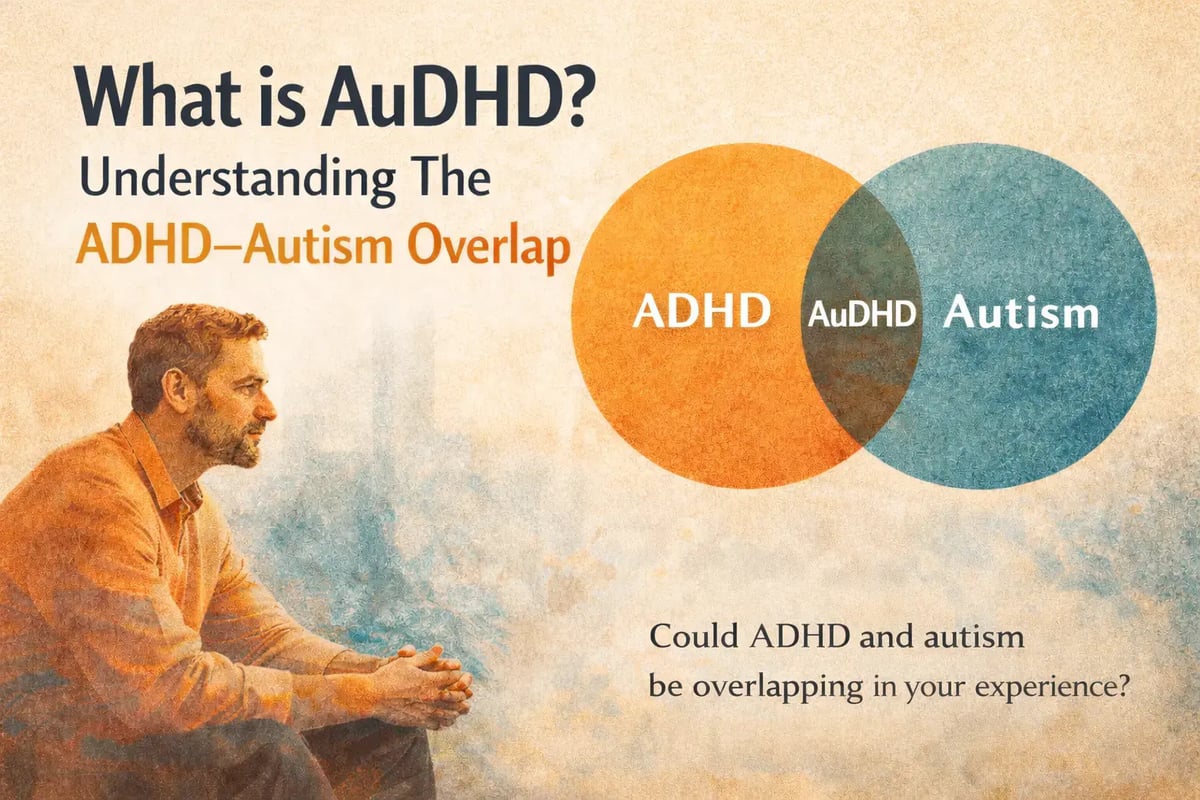
What is AuDHD? For many adults suffering with ADHD symptoms, there feels like something “more” is happening in their experience. Symptoms that cannot be explained by ADHD alone.
AuDHD could be the answer.
Autism and ADHD are shown to co-occur more often than not. But what does AuDHD mean, and how might it show up for you?
What is AuDHD?
AuDHD is a community term for the co-occurrence of autism and ADHD in the same person. It is not a separate clinical diagnosis — clinicians record autism and ADHD separately — but many neurodivergent adults use "AuDHD" because the two neurotypes interact to create an experience that neither diagnosis fully captures on its own.
Research suggests 50–70% of autistic people also meet criteria for ADHD.
AuDHD is not an official diagnostic term, but it is widely used to describe an individual who experiences both Autism Spectrum Disorder and ADHD together. Many individuals in the neurodivergent community use this term to describe their experience better.
For the sake of this blog post, keep in mind that AuDHD is a term used by the neurodivergent community to represent both of these neurodevelopmental differences. However, for the sake of clarity, AuDHD is often used by late-diagnosed adults and is not a separate diagnosis; it’s a term used to describe these co-occurring conditions.
Many people with both autism and ADHD resonate more with the term AuDHD because it represents their full spectrum of symptoms.
By Michael Holker, BSW, MSW, Published: July 2026
How ADHD and Autism Overlap in Adults
Neurodivergent symptoms that both Autism and ADHD share include:
- Executive dysfunction
- Sensory sensitivity
- Emotional regulation challenges
Where they differ:
ADHD = impulsivity, variability
Autism = predictability, sensory processing
The overlap between these two disorders can make diagnosis challenging. For example, ADHD traits tend to cause novelty-seeking, while autistics require a strict routine to feel grounded. From the outside, this creates an inconsistent pattern and can be confusing rather than simply resulting in an autistic diagnosis.
Adults with AuDHD learn to compensate early on in life. They may rely on structure to manage ADHD symptoms or use hyperfocus and push through environments that are actually overwhelming. Over time, this constant self-management can mask underlying traits, delaying recognition.
For a closer look at what the ADHD-autism journey looks and feels like over time, Understanding the ADHD-Autism Journeygoes deeper into the lived experience.
Common AuDHD Symptoms in Adults
The overlap between autism and ADHD can be a difficult thing to navigate, which is why identifying common symptoms they exhibit is essential. Not all symptoms are present in every person, so be advised that your experience may differ.
Emotional & Nervous System Patterns
- Emotional dysregulation (intense feelings, quick overwhelm, shutdowns)
- Heightened sensitivity to stress
- Strong internal reactions that may not be visible externally
Within AuDHD, these emotional and nervous system patterns can overlap with rejection sensitive dysphoria in ADHD and autism, where perceived rejection, criticism, or misunderstanding may trigger intense internal distress, overwhelm, or shutdown.Executive Function
- Problems planning, following through, and prioritizing various tasks
- Trouble starting tasks or stopping once hyperfocused
- Inconsistent attention
Sensory & Emotional Sensitivity
- Sensory overload (light, noise, textures, crowds)
- Need for stimulation and need for quiet and control
- Feeling exhausted by everyday environments
Those competing needs are one of the hardest parts of AuDHD to manage day to day — sensory overwhelm in neurodivergent adults breaks down why the same environment can be both under- and over-stimulating at once.
Masking & Burnout
- Long-term masking to appear “functional” or neurotypical
- Chronic fatigue or burnout, especially as an adult
- Feeling capable but constantly depleted
Identity & Internal Experience
- Feeling like ADHD and autism descriptions both fit your experience, but neither fully explains it.
- Feeling confused about what you need to feel better
- Persistent self-doubt or shame
Relationships & Daily Life - Difficulty balancing connection with the need for space
- Misunderstanding in communication or emotional expression
- Feeling “out of sync” with social expectations
Burnout is one of the most common and least understood experiences for AuDHD adults — the ultimate guide to autistic burnout covers what it is, why AuDHD adults are especially vulnerable, and what recovery actually looks like.
Those competing needs are one of the hardest parts of AuDHD to manage day to day — sensory overwhelm in neurodivergent adults breaks down why the same environment can be both under- and over-stimulating at once.
Why AuDHD is Often Missed in Adulthood
Autism and ADHD are often assessed separately, making overlapping traits harder to identify. Masking and compensation can hide symptoms well into adulthood. We get good at hiding our childhood experiences and continue to do so as we age. Symptoms are frequently misattributed to anxiety, depression, or burnout.
With time, however, coping strategies begin to fail, and many adults start wondering if what they are experiencing is something more than depression.
How is AuDHD different from ADHD or autism alone?
Autism and ADHD are different from each other. For example, conflictin are familiar to people who have both. Strategies that help with ADHD symptoms may worsen autistic overwhelm, and vice versa.
As you continue to seek a diagnosis, you may get conflicting responses from healthcare professionals. This results in increased fatigue from managing competing cognitive and sensory demands.
It also increases the risk of burnout due to constant self-adjustment.
For a deeper look at the cost of sustained self-monitoring and adaptation, you may also find this guide to masking burnout from performing neurotypically helpful.
Support Options for Late-Diagnosed AuDHD Adults
Working with a neurodivergent-affirming therapist to understand overlapping patterns is one of the best things you can do if you suspect you struggle with autism and ADHD. Support focused on self-understanding rather than fixing or correcting behaviour is another option to consider.
Learning strategies that respect both executive function and sensory needs (our guide to making home a sensory-safe space is one practical place to start). It’s important to address burnout, shame, and long-standing self-blame. Exploring accommodations and routines that align with individual capacity can also be helpful.
For adults in Ontario, virtual neurodiversity-affirming therapy can be a gentle place to start building strategies that fit how your mind actually works.
If reading this felt like someone finally put words to your experience, AuDHD therapy in Ontario is designed for adults exactly like you — people who've spent years wondering why neither diagnosis on its own quite told the whole story. If that recognition arrived late, recognizing ADHD and autism later in life brings its own particular mix of relief and grief worth being ready for.
If reading this felt like someone finally put words to your experience, the first step is to book a free 20-minute Meet-and-Greet — no pressure, just a conversation.
Frequently Asked Questions
What is AuDHD?
AuDHD is a community term for being both autistic and ADHD. It is not a separate diagnosis — clinicians record autism and ADHD individually — but many adults use the word because the two neurotypes interact to create an experience that neither label fully explains on its own.
Is AuDHD an official diagnosis?
No. AuDHD does not appear in the DSM-5 or any diagnostic manual. A person would receive two separate diagnoses: autism spectrum disorder and ADHD. It is also worth knowing that before the DSM-5 was published in 2013, clinicians were not permitted to diagnose both in the same person. That history is one reason so many adults were given only half of the picture, or were missed entirely.
How common is AuDHD?
Autism and ADHD co-occur far more often than was once believed. Research suggests that roughly 50 to 70 percent of autistic people also meet criteria for ADHD, and a meaningful portion of people with ADHD show autistic traits as well. Estimates vary between studies, partly because the two conditions have only been diagnosed together since 2013, so these numbers are best held as a range rather than a fixed figure.
How can I tell if I’m AuDHD? Is there an AuDHD test?
There is no single validated test for AuDHD. Online quizzes can support self-reflection, but they cannot diagnose, and a formal assessment looks at autism and ADHD separately. Many adults first recognize themselves in the pattern rather than a score: ADHD descriptions fit, autism descriptions fit, and neither one tells the whole story.
What does AuDHD feel like in adults?
Many adults describe AuDHD as an internal push and pull. One part craves novelty and stimulation while another needs routine, quiet, and predictability — sometimes within the same hour. Common experiences include executive function difficulty, sensory overwhelm alongside stimulation-seeking, intense emotions and rejection sensitivity, long-term masking, and a sense of being out of sync with social expectations. Not everyone experiences all of these, and the mix can shift with stress and environment.
How is AuDHD different from ADHD or autism alone?
With AuDHD, the traits do not simply add together — they often conflict with and amplify each other. A routine built for stability can be derailed by ADHD novelty-seeking, and adding stimulation for ADHD may worsen autistic overwhelm. Each neurotype can also mask the other, which is why support designed for one profile alone so often falls short.
Why is AuDHD so often missed in women and late-diagnosed adults?
AuDHD is often missed because autism and ADHD are usually assessed separately, and because years of masking and compensation can hide both. Research suggests women and gender-diverse people are especially likely to be overlooked, in part because diagnostic criteria were built largely around how boys present, and in part because social expectations reward camouflaging. Traits are then frequently attributed to anxiety, depression, or burnout. Being missed says something about the systems doing the looking. It says nothing about whether your experience is real.
What does AuDHD burnout look like?
AuDHD burnout often shows up as deep exhaustion that rest does not fix, reduced tolerance for sensory input, loss of skills that used to feel manageable, and withdrawal from people and demands. It tends to build slowly from constant self-adjustment — managing two sets of competing needs while appearing fine. It is frequently mistaken for depression, although the two can also occur together. Our guide to autistic burnout and our piece on neurodivergent burnout recovery go further into what helps.
Is there treatment or medication for AuDHD?
There is no single treatment for AuDHD, because it is not something to be cured. Support usually means understanding how both neurotypes interact and building strategies that respect executive function and sensory needs together. Some people find ADHD medication helpful, and responses can differ when autism is also present; that is a conversation for a physician or nurse practitioner, as medication falls outside the scope of psychotherapy. Neurodiversity-affirming therapy can help with the burnout, shame, and long-standing self-blame that so often travel alongside. You can book a free 20-minute meet-and-greet if you would like to talk it through.
Key Takeaways
- AuDHD is a community term, not a separate diagnosis. It describes the co-occurrence of autism and ADHD in one person — clinicians record the two separately, but the term captures an experience neither diagnosis fully explains on its own. Research suggests 50–70% of autistic people also meet criteria for ADHD.
- Common AuDHD symptoms in adults include conflicting needs. The pull between ADHD-driven novelty-seeking and autistic needs for routine and predictability is a hallmark, alongside executive dysfunction, sensory sensitivity paired with stimulation-seeking, emotional dysregulation, and long-term masking that leads to burnout.
- AuDHD feels different from autism or ADHD alone because the traits conflict and amplify each other. Routines carefully built for stability can be derailed by distractibility or novelty-seeking, and strategies that help one profile can worsen the other — making daily life and self-understanding harder than either neurotype alone.
- AuDHD is often missed in adulthood because assessment and masking work against recognition. Autism and ADHD are usually assessed separately, years of compensation hide overlapping traits, and symptoms are frequently misattributed to anxiety, depression, or burnout — often until coping strategies begin to fail.
- Support starts with understanding, not fixing. Neurodivergent-affirming therapy focused on self-understanding, strategies that respect both executive function and sensory needs, and addressing burnout and long-standing self-blame are the foundations of support for late-diagnosed AuDHD adults.
Resources
Craig, F., Margari, F., Legrottaglie, A. R., Palumbi, R., de Giambattista, C., & Margari, L. (2016). A review of executive function deficits in autism spectrum disorder and attention-deficit/hyperactivity disorder. Neuropsychiatric Disease and Treatment, 12, 1191–1202. https://doi.org/10.2147/NDT.S104620
Hours, C., Recasens, C., & Baleyte, J.-M. (2022). ASD and ADHD comorbidity: What are we talking about? Frontiers in Psychiatry, 13, 837424. https://doi.org/10.3389/fpsyt.2022.837424
Lebeña, A., Faresjö, Å., Faresjö, T., & Ludvigsson, J. (2023). Clinical implications of ADHD, ASD, and their co-occurrence in early adulthood—the prospective ABIS-study. BMC Psychiatry, 23, 851. https://doi.org/10.1186/s12888-023-05298-3
Perry, E., Mandy, W., Hull, L., & Cage, E. (2022). Understanding camouflaging as a response to autism-related stigma: A social identity theory approach. Journal of Autism and Developmental Disorders, 52(2), 800–810. https://doi.org/10.1007/s10803-021-04987-w
Townes, P., Liu, C., Panesar, P., Devoe, D., Lee, S. Y., Taylor, G., Arnold, P. D., Crosbie, J., & Schachar, R. (2023). Do ASD and ADHD have distinct executive function deficits? A systematic review and meta-analysis of direct comparison studies. Journal of Attention Disorders. https://doi.org/10.1177/1087054723119049
This article is for educational purposes only and is not a substitute for individualized therapy or medical advice. If you are in crisis, please contact emergency services or a crisis line in your area.
Blog Disclaimer
This blog may include occasional personal reflections or composite-style anecdotes to illustrate therapeutic ideas and foster connection. Any identifying details have been altered, omitted, or generalized to protect confidentiality. These examples are shared for educational purposes only. Every person’s experience is unique, and what resonates with one individual may not apply to another.
The content on this website is provided for educational and informational purposes only and is not a substitute for medical advice, mental health advice, diagnosis, or treatment. Reading this blog does not establish a therapist-client relationship. If you have concerns about your mental health, physical health, or overall well-being, please consult a qualified healthcare provider or licensed mental health professional.
Psychotherapy services described on this website are available to residents of Ontario, in accordance with applicable professional standards and the scope of practice. If you are interested in working together or would like to schedule a complimentary 20-minute consultation, you are welcome to contact me through my practice.
These resources are offered to support reflection, learning, and self-understanding as you move toward a more grounded, authentic, and meaningful life.
Tags:

Michael Holker MSW, RSW
Jan 30, 2026, 11:00:00 AM
Jan 30, 2026, 11:00:00 AM
Michael Holker, MSW, RSW, is a Registered Social Worker and Psychotherapist who practices neurodiversity-affirming therapy and is the founder of Becoming Yourself Counselling and Consulting — a virtual practice based in Toronto that serves adults across Ontario. He works with late-diagnosed and self-identified autistic, ADHD, AuDHD and gifted (2e) adults, bringing lived experience of neurodivergence to a trauma-informed, strengths-based approach. He practises alongside Euodia Leung, MSW, RSW, whose focus is anxiety, depression and self-esteem. Book a free 20-minute meet-and-greet.