

Sensory Overload in Neurodivergent Adults: What Is Actually Happening and How to Find Relief in Ontario
“Great spirits have always encountered violent opposition from mediocre minds.”
— Albert Einstein
By: Michael Holker BSW, MSW Registered Social Worker | Psychotherapist
This article explains why some adults with ADHD feel shame, fear, or pressure when they stand out or succeed, and how masking history, rejection-sensitive dysphoria, fear of positive evaluation, and self-compassion help explain the urge to shrink after visibility.
Sometimes the hardest part is not getting the opportunity.
It is what happens after.
You receive the praise. The promotion. The recognition. The confirmation that the thing you made mattered.
And instead of feeling uncomplicated pride, you feel your body tighten.
You start downplaying it. Explaining it away. Making yourself smaller. Bracing for envy, pressure, scrutiny, or disappointment.
You may even feel embarrassed that you wanted to be seen in the first place.
This is one way tall poppy syndrome dynamics can show up for neurodivergent adults — and especially for people navigating the overlapping experience of AuDHD.
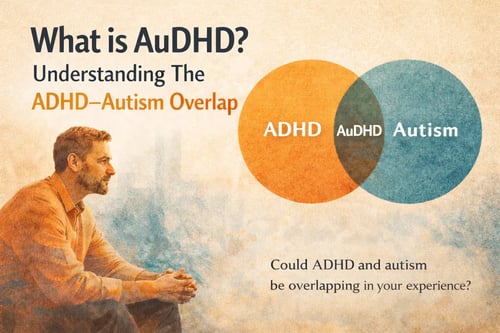
If you are still making sense of that overlap, this guide on what AuDHD is may help clarify why autistic and ADHD traits can interact in ways that affect visibility, masking, emotional regulation, sensitivity to evaluation, and the complicated experience of being seen.
I am using "tall poppy syndrome" here as a cultural and psychological lens rather than as a formal diagnosis. It names a pattern many people recognize: when visibility feels risky, success can trigger self-protection instead of relief.
For some AuDHD adults, being seen is not simply affirming. It can feel exposing.
That does not mean there is something wrong with you for struggling with success. It often means success is touching something older — fear of being judged, pressure to keep performing, the memory of being cut down for standing out, or the uneasy knowledge that attention has not always felt safe.
This article explores that pattern through a neurodivergent lens. It asks why visibility can feel so charged, why many high-capacity AuDHD adults learn to shrink, and why self-compassion often helps far more than forcing confidence.
Why AuDHD Adults May Feel Success Differently
AuDHD is not a single personality style. But many adults navigating both autistic and ADHD traits describe a life shaped by intensity, contradiction, and uneven fit.
You may think deeply and move quickly. You may notice patterns others miss while struggling to explain them under pressure. You may produce brilliant work in bursts while feeling chaotic or unreliable in between. You may crave stimulation and novelty while also becoming overwhelmed by noise, pace, or demand. You may want to be seen accurately and also feel terrified of scrutiny.
This complexity matters when we think about success.
If success were only about merit, recognition might feel straightforward. But for many neurodivergent adults, success is entangled with history. Standing out may have once led to ridicule, misunderstanding, jealousy, isolation, or unrealistic expectations. Being praised may have meant more pressure was coming next. Being described as "gifted," "smart," or "promising" may have made your struggles feel less legible, not more.
So the nervous system learns something complicated: visibility is not neutral.
That is one reason success can feel unsafe. It is not only about the present moment. It is about what the present moment reminds your body to anticipate.
Key Takeaways
- Some AuDHD adults feel uneasy after success because visibility can trigger shame, fear, rejection-sensitive dysphoria, or old experiences of being cut down when they stood out.
- Tall poppy syndrome is best used as a cultural and psychological lens here, not a formal clinical diagnosis — but the pattern it names is emotionally real and often historically grounded.
- Fear of positive evaluation, rejection-sensitive dysphoria, and autistic masking history can all help explain why being seen feels threatening rather than simply rewarding.
- Self-compassion is often more helpful than self-pressure because shrinking is usually rooted in fear and shame, and self-criticism rarely creates the internal safety that allows visibility to feel survivable.
- Taking up space can be quiet and grounded — it does not require becoming louder or harder; it requires becoming less willing to systematically disappear.
Tall Poppy Syndrome Through an AuDHD Lens
Tall poppy syndrome usually refers to the social tendency to criticize, resent, or cut down people who stand out. In a neurodivergent context, it can also describe what happens internally when a person has learned to expect that standing out will cost them.
Instead of waiting only for others to cut them down, they start doing some of that work themselves.
They minimize their strengths. They apologize for their visibility. They downplay their achievement before anyone else can react to it. They move quickly from success into self-critique. They become suspicious of recognition.
This pattern can be especially painful for people who are genuinely growth-oriented. Many AuDHD adults are curious, driven, thoughtful, and deeply committed to learning. They want to contribute. They want to create. They want their work to matter.
But if growth has repeatedly collided with judgment, the desire to expand can become tangled with the urge to hide. That tension is part of what makes this topic so emotionally loaded. It is not just about insecurity. It is about the body asking whether success is survivable.
For the broader picture of how Tall Poppy Syndrome operates — and why neurodivergent and gifted adults are especially affected — Understanding Tall Poppy Syndrome is the companion post.
A Reflection From My Own Work
I find this topic personally resonant, and not only because I see it in the people I work with.
There is a particular quality to the experience of receiving recognition when your nervous system has not yet learned to trust it. It is not ingratitude. It is not false modesty. It is something more like bracing — a quiet, physical preparation for something to go wrong.
For me, a lot of that bracing had to do with inconsistency. When your output is variable, praise can feel precarious. You think: they are seeing me at my best, and they don't know how unreliable the rest looks. So the recognition feels less like confirmation and more like pressure — proof of a standard you are now expected to sustain.
What I have come to understand, both personally and clinically, is that the fear underneath this is rarely about wanting to fail. It is about not wanting to be caught. Not wanting to be exposed as someone who is not as capable as the recognition suggests. That fear deserves to be approached with curiosity and care — not pushed past, and not confirmed by turning away from what was earned.
Rejection Sensitive Dysphoria, RSD, and the Cost of Being Seen
We often think of social anxiety in terms of fear of criticism. That fear matters here. But it is not the whole story.
Rejection sensitive dysphoria — RSD — is an intense emotional response to perceived or actual criticism, failure, or rejection that is strongly associated with ADHD and AuDHD profiles. For people who experience it, the emotional intensity of a single negative signal can be dramatically disproportionate to its actual weight. Past perceived failures or rejections can leave the nervous system on alert long after the original event. For day-to-day strategies, see living with RSD as a neurodivergent adult.
If this kind of emotional pain feels immediate, intense, or difficult to settle after perceived criticism, rejection, or shifts in how others respond to you, this guide on what RSD is and how it can show up in ADHD and autism may help explain why visibility can feel so threatening even when the feedback is positive.
What is less often discussed is that some AuDHD adults also experience what researchers call fear of positive evaluation — a state in which being seen itself favourably feels threatening. Research by Fredrick and Luebbe (2020) confirms that positive attention can increase perceived exposure, heighten the stakes of future disappointment, and trigger anticipatory anxiety about being found wanting. In simpler terms, when being praised feels like setting yourself up for a harder fall, praise does not simply feel good.
Put together with masking history, the pattern becomes recognizable:
If you have spent years monitoring yourself to avoid getting things wrong, then visibility does not simply feel rewarding. It increases the number of places where you could be misread, envied, criticized, or found wanting. RSD means even small signs of potential disappointment can land with enormous force.
That can make shrinking feel like the only sensible self-protection.
For a broader look at how neurodiversity-affirming therapy can support emotional regulation, rejection sensitivity, masking, and self-understanding, you can read more about how I work with neurodivergent adults in Ontario.
Why AuDHD Adults Feel This So Intensely
There is no single paper proving AuDHD adults specifically experience tall poppy syndrome. That is important to say clearly. What we do have is a meaningful convergence of evidence.
Autistic and ADHD traits often co-occur in adulthood (Polderman et al., 2014). Adults with ADHD describe stigma, inconsistent performance, identity tension, and emotional intensity in the lived-experience literature (Ginapp et al., 2022). Masking and camouflaging research shows that many autistic adults expend significant energy managing how they are perceived, and that this effort increases with perceived threat of judgment (Cook et al., 2021; Zhuang et al., 2025). Rejection-sensitive dysphoria can intensify how any form of evaluation — positive or negative — lands in the body.
In practice, for many AuDHD adults this can mean:
- Your originality stands out, but so does your inconsistency
- Your insight gets praised, but your overwhelm gets misunderstood
- Your intensity helps you create, but also makes you feel exposed
- Your success draws people closer, while your nervous system prepares for impact
- Being seen accurately feels almost impossible when the visible self and the private experience feel so different
This is one reason AuDHD adults may oscillate between wanting to be recognized and wanting to disappear. The internal experience is not hypocrisy. It is complex — and it makes a great deal of sense when you understand the neurology behind it.
For a broader grounding in the layered nature of the AuDHD profile, giftedness, twice-exceptionality, and the neurodivergent identity explores how intensity and visibility often intersect in 2e adults.
Shame, Autistic Masking, and the Urge to Shrink After Success
When people hear about someone hiding after success, they sometimes assume modesty or imposter syndrome is the whole story. Often, shame is closer to the centre.
Shame says:
Do not get too big. Do not need too much. Do not become a target. Do not assume you deserve this. Do not let them see how much this matters to you.
That voice can sound humble from the outside. Internally, it is often harsh and frightened.
Autistic masking plays a significant role here, too. If you have spent years learning how to be acceptable — how to manage the impression others have of you, how to stay within the range of what draws approval — then success may threaten the mask. More visibility means more possibility of being known beyond the edited version. Some people can tolerate being admired only if they can stay in control of how they are seen. Success disrupts that control.
That gap between being admired and being known has a cost of its own, and we wrote about it directly in gifted adult loneliness: when being known feels impossible.
This is also where rejection-sensitive dysphoria and the masking pattern interweave most painfully. The very thing that made you capable enough to achieve is often the thing the mask was hiding. When your work is celebrated, the question underneath can become: but would they still celebrate me if they knew the full picture?
Why Self-Pressure Usually Backfires
Many people respond to this pattern by trying to bully themselves out of it.
Be confident. Own it. Stop overthinking. Just put yourself out there.
Sometimes those messages create momentum. Often, they add one more layer of shame. If shrinking is rooted in fear, self-criticism rarely creates safety. It simply tells the system that even its self-protective reflexes are now failing too.
This is why self-compassion matters here — not as a soft extra, but as the actual mechanism of change.
Current research on self-compassion confirms it is associated with better psychological outcomes in adults and may work partly by reducing repetitive negative thinking and secondary distress (Wang et al., 2025). Compassion-focused therapy research similarly suggests compassion-based approaches can meaningfully reduce self-criticism and improve regulatory capacity even in complex presentations (Millard et al., 2023; Craig et al., 2020).
Self-compassion in this context does not mean pretending visibility is easy. It does not mean forcing yourself to enjoy being watched. It does not mean inflating yourself artificially. It means meeting the part of you that wants to shrink with understanding instead of contempt, which is exactly what that part of you has rarely received.
For more on building self-compassion as a foundation for this kind of work, self-compassion and acceptance for neurodivergent adults explores what that inner shift actually looks like in practice.
What Taking Up Space Can Actually Mean for AuDHD Adults
Taking up space is one of those phrases that can sound inspiring and also oddly performative.
For some people, it conjures images of becoming louder, bolder, or endlessly self-promoting. That is not the version I mean here.
For many AuDHD adults, taking up space more sustainably may mean:
- Not apologizing for every strength before someone else notices it
- Letting your work matter without immediately disowning it
- Staying present long enough to actually receive appreciation
- Noticing when your body moves into hiding mode — and pausing before following it there automatically
- Distinguishing protective caution from habitual self-erasure
- Letting success be information rather than a test verdict you will inevitably fail
Sometimes it also means grieving what success has cost in the past. For gifted and twice-exceptional adults, this grief can be especially complicated when visibility has brought both praise and pressure. My page on therapy for gifted adults in Ontario explores how therapy can support people who are learning to relate to their intensity, sensitivity, intelligence, and achievement without turning those strengths into another source of self-erasure.
If attention has brought conflict, envy, pressure, or emotional isolation, then of course the nervous system has questions. It may not be trusted yet. That trust is not built through force. It is built through repeated experiences of not abandoning yourself when you are seen.
A More Compassionate Relationship With Visibility
One of the most powerful shifts available in this work is moving from:
Why can't I just be more confident?
to:
What happens in me when I become visible?
That second question opens a door.
Maybe you notice tension in the chest. Maybe you hear an old family voice. Maybe you feel the urge to minimize before someone else can. Maybe you realize praise makes you brace for future disappointment. Maybe you recognize rejection-sensitive dysphoria operating in real time — the nervous system treating positive attention as a precursor to a harder fall.
Those are not signs that you are broken. They are signs that visibility has meaning for you — deep, historically grounded, emotionally real meaning.
Once that meaning becomes more conscious, you have more room to respond differently. You can practice receiving a kind word without cancelling it immediately. You can notice the urge to shrink and stay with it a moment longer. You can let achievement be real without turning it into a test of worth. You can begin to build a life where standing out does not require self-betrayal.
If expectations and the pressure to remain within invisible limits are woven through this pattern, breaking free from expectations as a neurodivergent adult looks at the broader terrain of inherited rules and the gradual work of loosening their grip.
You Do Not Need to Become Smaller to Be Safer
There are times when strategic privacy makes sense. Not every room deserves full access to you. Not every audience is safe. Discernment matters.
But chronic shrinking is different.
When a person repeatedly edits themselves downward to avoid being judged, envied, misunderstood, or pressured, they often lose more than visibility. They lose permission to inhabit their own gifts without apology. They lose access to the parts of themselves that were actually doing something worth celebrating.
Breaking free from tall poppy dynamics does not mean becoming immune to shame overnight. It means learning that success does not always require self-reduction. It means letting more of your real size exist without meeting it immediately with fear or contempt.
For many AuDHD adults, that is deeply emotional work. It is not vanity. It is not ego. It is a repair.
If being seen has often felt costly, you do not have to solve that all at once. But you may be ready to stop assuming that shrinking is the only way to stay safe.
Sometimes the next step is not becoming bigger. It is becoming less willing to disappear.
If you recognize yourself in this — the body that tightens after recognition, the urge to explain away your own success before anyone else can question it, the exhaustion of wanting to be seen and fearing what that costs — that recognition is worth something.
At Becoming Yourself Counselling, I work with AuDHD adults navigating shame, visibility, rejection sensitivity, and the long work of learning that success does not have to require self-betrayal.
You can learn more about AuDHD therapy for adults navigating shame and visibility if you would like support that understands the emotional complexity of being seen, misunderstood, gifted, sensitive, intense, or inconsistent in ways others may not fully recognize.
As a neurodiversity-affirming therapist based in Toronto, I offer virtual AuDHD therapy to adults anywhere in Ontario — including Toronto, Ottawa, Hamilton, Mississauga, and beyond. If this resonates with your experience, book a free 20-minute Meet-and-Greet.
Frequently Asked Questions
Why does success make me want to disappear?
Because visibility can activate fear of judgment, anticipatory pressure, or old experiences where standing out came with a real cost. For many AuDHD adults, rejection-sensitive dysphoria adds an additional layer — even positive attention can trigger the nervous system to brace for a harder fall later. That response is not irrational. It is a learned protection, and understanding it as such is often the beginning of changing the relationship with it.
Is tall poppy syndrome a real clinical diagnosis?
No. It is better understood as a cultural and psychological pattern — a useful lens for naming the experience of shrinking after success or feeling unsafe when standing out — rather than a formal clinical syndrome. The emotional experiences it describes, however, are real and often traceable to specific histories of judgment, inconsistency, or the cost of visibility.
Why might AuDHD adults relate to this pattern so strongly?
Because intensity, originality, autistic masking history, inconsistent performance, and rejection-sensitive dysphoria can all make visibility feel genuinely complicated rather than simply affirming. Many AuDHD adults have received contradictory feedback — praised for their capacity, criticized for their inconsistency — in ways that make recognition feel unstable rather than trustworthy.
How does self-compassion help with the urge to shrink?
It reduces shame and self-attack, which are usually underneath the shrinking rather than separate from it. When the response to visibility is self-criticism — you don't deserve this, wait until they see the rest — self-compassion interrupts that loop rather than adding to it. That is not a soft extra. Research consistently shows it meaningfully reduces the secondary distress and repetitive negative thinking that keep people stuck in cycles of shame and self-reduction.
References
Cook, J., Hull, L., Crane, L., & Mandy, W. (2021). Camouflaging in autism: A systematic review. Clinical Psychology Review, 89, 102080. https://pubmed.ncbi.nlm.nih.gov/34537517/
Craig, C., Hiskey, S., & Spector, A. (2020). Compassion-focused therapy: A systematic review of its effectiveness and acceptability in clinical populations. Expert Review of Neurotherapeutics, 20(4), 385–400. https://doi.org/10.1080/14737175.2020.1746184
Fredrick, J. W., & Luebbe, A. M. (2020). Fear of positive evaluation and social anxiety: A systematic review of trait-based findings. Journal of Affective Disorders, 265, 157–168. https://pubmed.ncbi.nlm.nih.gov/31972293/
Ginapp, C. M., Macdonald-Gagnon, G., Angarita, G. A., Bold, K. W., & Potenza, M. N. (2022). The lived experiences of adults with attention-deficit/hyperactivity disorder: A rapid review of qualitative evidence. Frontiers in Psychiatry, 13, 949321. https://doi.org/10.3389/fpsyt.2022.949321
Millard, L. A., Wan, M. W., Smith, D. M., & Wittkowski, A. (2023). The effectiveness of compassion focused therapy with clinical populations: A systematic review and meta-analysis. Journal of Affective Disorders, 326, 168–192. https://doi.org/10.1016/j.jad.2023.01.010
Polderman, T. J. C., Hoekstra, R. A., Posthuma, D., & Larsson, H. (2014). The co-occurrence of autistic and ADHD dimensions in adults. Translational Psychiatry, 4(9), e435. https://pubmed.ncbi.nlm.nih.gov/25203169/
Wang, J., Drossaert, C. H. C., Knevel, M., Chen, L., Bohlmeijer, E. T., & Schroevers, M. J. (2025). The mechanisms underlying the relationship between self-compassion and psychological outcomes in adult populations: A systematic review. Stress and Health. https://doi.org/10.1002/smi.70090
Zhuang, S., Bougoure, M., Leong, D.-J., Dean, L., Reddrop, S., Naragon-Gainey, K., Maybery, M., Tan, D. W., & Magiati, I. (2025). Examining an integrated path model of psychological and sociocultural predictors of camouflaging in autistic adults. Autism, 29(9), 2328–2343. https://doi.org/10.1177/13623613241262110
This article is for educational purposes only and is not a substitute for individualized therapy or medical advice. If you are in crisis, please contact emergency services or a crisis line in your area.
Michael Holker is a Registered Social Worker and neurodiversity-affirming therapist offering virtual therapy across Ontario for adults with ADHD, autism, AuDHD, giftedness, and twice-exceptionality. Learn more about working with Michael →
Disclaimer
This blog may include occasional personal reflections or composite-style anecdotes to illustrate therapeutic ideas and foster connection. Any identifying details have been altered, omitted, or generalized to protect confidentiality. These examples are shared for educational purposes only. Every person's experience is unique, and what resonates with one individual may not apply to another.
The content on this website is provided for educational and informational purposes only and is not a substitute for medical advice, mental health advice, diagnosis, or treatment. Reading this blog does not establish a therapist-client relationship. If you have concerns about your mental health, physical health, or overall well-being, please consult a qualified healthcare provider or licensed mental health professional.
Psychotherapy services described on this website are available to residents of Ontario, in accordance with applicable professional standards and the scope of practice. If you are interested in working together or would like to schedule a complimentary 20-minute consultation, you are welcome to contact me through my practice.
These resources are offered to support reflection, learning, and self-understanding as you move toward a more grounded, authentic, and meaningful life.

Michael Holker MSW, RSW
Nov 5, 2025, 9:34:45 AM
Nov 5, 2025, 9:34:45 AM
Michael Holker, MSW, RSW, is a Registered Social Worker and Psychotherapist who practices neurodiversity-affirming therapy and is the founder of Becoming Yourself Counselling and Consulting — a virtual practice based in Toronto that serves adults across Ontario. He works with late-diagnosed and self-identified autistic, ADHD, AuDHD and gifted (2e) adults, bringing lived experience of neurodivergence to a trauma-informed, strengths-based approach. He practises alongside Euodia Leung, MSW, RSW, whose focus is anxiety, depression and self-esteem. Book a free 20-minute meet-and-greet.