

Neurodivergent Burnout Recovery: What It Actually Takes to Heal — and What Gets in the Way
"Within you, there is a stillness and a sanctuary to which you can retreat at any time and be yourself." — Hermann Hesse
Home is supposed to be where the nervous system calms down.
For many neurodivergent adults, that is not automatically true.
The light overhead is too sharp — the kind that leaves behind a faint pressure behind the eyes that accumulates over hours. The refrigerator hums at a frequency that is somehow always just audible enough to register but not quite loud enough to justify mentioning. The blanket on the couch is scratchy in a way that becomes impossible to ignore the moment you notice it. The visual scatter of the kitchen counter keeps pulling your attention even when you are trying to rest. The lingering smell of the cleaning products used three hours ago is still present in a way that others in the house genuinely do not understand.
What other people experience as background becomes, for a neurodivergent nervous system, a constant and effortful negotiation. And that negotiation has a cost — one that is rarely counted because it rarely shows up in obvious ways. It shows up instead as fatigue that sleep does not fully resolve. As irritability that seems disproportionate to what is obviously happening. As the persistent inability to actually come down, even in the place that is supposed to be the most regulated in your life.
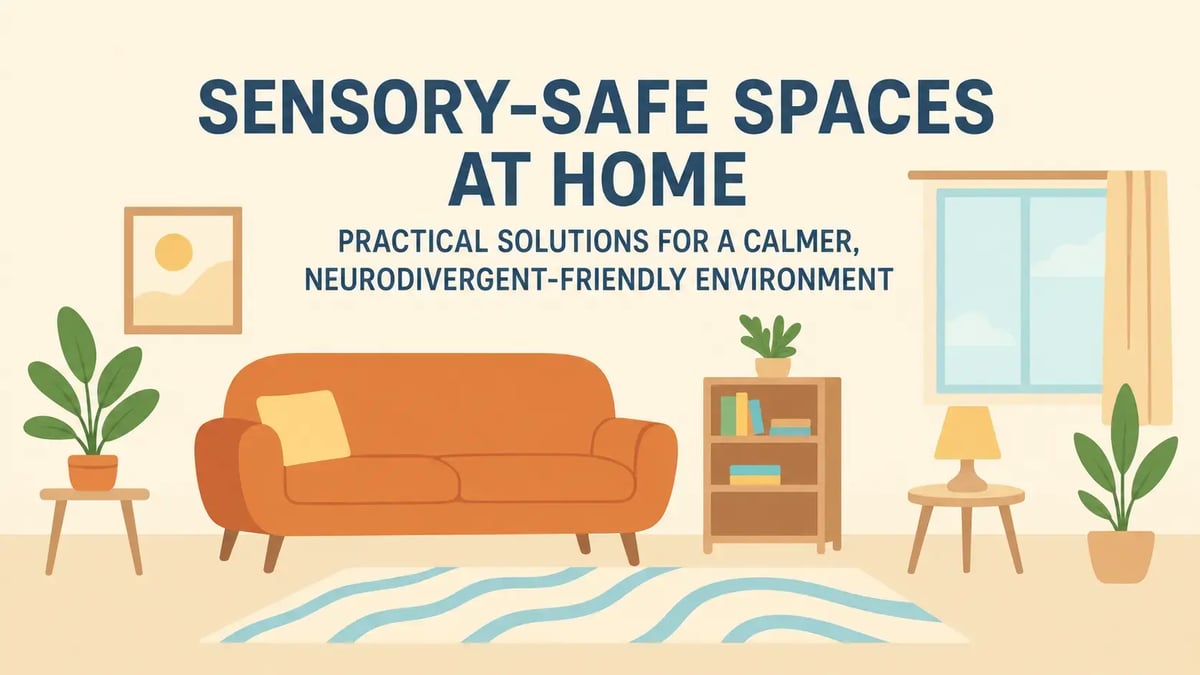
This is why a sensory-safe home matters — not as a luxury or an indulgence, but as a genuine support for nervous system regulation. Not because sensitivity is fragility, but because regulation depends on fit. And fit, for many neurodivergent adults, has to be deliberately constructed rather than assumed.
What does sensory safety mean?
A sensory-safe home is an environment designed to support nervous system regulation by reducing unnecessary sensory load and providing predictable, adjustable sensory conditions — so the body can actually rest rather than continuing to work.
That definition is worth pausing on, because sensory safety is frequently misunderstood as a particular aesthetic. People imagine it must mean white walls, empty surfaces, complete silence, a kind of curated minimalism that belongs to a design magazine. That is not what sensory safety means — and that framing, if accepted, puts the whole project out of reach for most people.
Sensory safety is not about making a home look calm from the outside. It is about creating enough predictability, flexibility, and regulation support that your particular nervous system can exhale there.
For one person, that might mean:
- Warm lamps instead of overhead lighting
- A consistent background sound that masks sudden noise
- A weighted blanket in the most-used resting spot
- Surfaces that are visually quieter in the rooms that matter most
- A corner or room that is specifically protected for decompression
For another person, it might mean the opposite on several dimensions:
- Stronger proprioceptive input through weighted tools or compression
- More textural variety in deliberately chosen places
- Higher stimulation in one space for focus, lower in another for rest
- Movement options are integrated into the home rather than relegated to a gym
The central question is never: What looks calm from the outside? It is always: What actually helps my body stay more regulated in here?
That distinction matters enormously — and it is the one that most home organization advice misses entirely. Most advice is written for average nervous systems, and average nervous systems are not the ones for whom the refrigerator hum is a real problem.
Why the Home Environment Matters More Than Most Neurodivergent Adults Realize
Many neurodivergent adults spend a significant portion of their days managing environments that were not designed for them.
They may mask at work — consciously modulating tone, expression, and communication style to remain legible and professionally acceptable. They navigate offices with open-plan noise, fluorescent lighting, and the constant unpredictability of other people's schedules. They manage public transit, grocery stores, waiting rooms, and social spaces that impose sensory demands without any option for adjustment. They hold themselves together across a full day of this, often with a skill and consistency that looks, from the outside, like total ease.
And then they arrive home.
If home is also asking the nervous system to keep working — to manage lighting that is too sharp, sounds that are too sudden, textures that are wrong, visual scatter that keeps demanding attention — then the system never actually gets a chance to come down. Recovery becomes incomplete. The baseline state stays elevated. Things that should feel manageable feel hard. Sleep can become more difficult. The window of tolerance — the range within which ordinary demands feel possible rather than overwhelming — narrows.
This is one reason so many neurodivergent adults find themselves wondering: Why am I so irritable here? Why can't I relax in my own house? Why do small things feel so disproportionately hard when I finally get home?
Sometimes the answer has nothing to do with the events of the day. Sometimes the answer is that the home environment itself is still asking the nervous system to work.
Research by Chen and colleagues (2024) documented that sensory processing differences in autistic adults are meaningfully associated with internalizing and externalizing distress — not as a separate problem, but as a consistent dimension of how the nervous system interacts with its environment. Research by Bagatell and colleagues (2022) on participation in autistic adults showed that sensory patterns shape where people go, how long they stay, and what environments feel usable at all. These findings support what many neurodivergent adults already know from lived experience: environment is never neutral. The body is always in a relationship with the room.
When the room is not working, the relationship is costly.
A sensory-safe home for neurodivergent adults is a living environment designed to reduce unnecessary sensory load and provide predictable, adjustable sensory conditions that support nervous system regulation rather than demanding ongoing regulatory effort. For adults with ADHD, autism, AuDHD, or other neurodivergent profiles, home environments that are not sensory-compatible prevent genuine recovery from the masking, sensory management, and regulatory demands of daily life — contributing to fatigue, irritability, executive function challenges, and burnout. Creating a sensory-safe home typically involves targeted adjustments to lighting, sound, texture, visual load, and functional zoning — calibrated to the individual's specific sensory profile rather than to a generic standard of calm — and often requires permission to trust sensory experience and design around it.
If you’re reading this and realizing your home has been asking more of your nervous system than you knew — you don’t need to redesign anything tonight. Sometimes the first change is being understood. Here’s who we are, if you’d like to see whether that would help.
Common Signs That Your Home Environment Is Not Working for Your System
The signs are not always dramatic, and that is part of what makes them easy to overlook or misattribute.
You may notice that you avoid certain rooms without quite knowing why — there is something about the quality of the light, or a particular sound in that space, or the way it is configured that makes it consistently feel wrong. You notice your shoulders tense when you enter the kitchen. The visual complexity of a counter that you know is not even particularly cluttered somehow pulls your attention away from what you are trying to do.
Or you find that you feel consistently more irritable at home than you do at work, which seems paradoxical — shouldn't the more comfortable place produce more comfort? But the sensory conditions of your workplace may actually be more predictable, or the specific sensory stressors may be different in ways that matter to your system.
You may notice that housework feels genuinely impossible — not just difficult or unpleasant, but encountered with a kind of resistance that goes beyond motivation. Sometimes this is because the sensory conditions around the task are aversive: the smell of the products, the texture of surfaces, the noise of appliances. The avoidance is not laziness. It is the body making an accurate report about conditions.
You may notice that you need extreme quiet after being in busy environments — and that achieving that quiet at home requires active effort rather than being the default state.
For some people, these patterns trace to one strong sensory trigger. For others, it is cumulative: the lighting is mildly stressful, and the sound is mildly stressful, and the visual load is mildly stressful, and together they create a background level of activation that never fully turns off. The system is not being overwhelmed by any single thing. It is simply never getting a break from the aggregate.
That aggregate is what sensory overload actually is — and understanding how it builds in a neurodivergent nervous system makes it much easier to work out which changes below are worth making first.
This is one reason sensory safety often needs to be approached systematically — not looking for the one perfect fix, but asking where the friction is quietly adding up.
Practical Sensory Overload Solutions at Home
The most useful sensory changes are often practical rather than dramatic. They do not require renovation, significant expense, or a perfectly curated aesthetic. They require accuracy — a genuine understanding of which sensory conditions are creating the most friction, and targeted adjustments in those areas.
Lighting
Lighting affects neurodivergent nervous systems more profoundly and more commonly than most people realize. Harsh overhead lights, cool-toned bulbs, flicker, glare, and strong visual contrast can all increase physiological stress and cognitive fatigue over hours — often without the person fully connecting the accumulation to its source.
Practical adjustments worth trying:
- Replace overhead reliance with lamps where possible — the quality of light from a lamp is typically warmer, softer, and more directional, creating less ambient glare
- Choose warmer bulbs (2700–3000K) in resting spaces
- Add dimmers, or use smart bulbs with adjustable colour temperature
- Use curtains or adjustable blinds to control natural light that arrives at particularly harsh angles
- Task lighting for focused work rather than flooding the entire room with brightness
Sometimes changing a single lamp in the room where you rest changes the felt quality of that room more than any other modification.
Sound
Sound is often the most significant driver of home-based dysregulation, and one of the most individually variable. For some people the issue is sudden, unpredictable noise. For others it is repetitive, ambient sound that becomes impossible to un-notice once registered. For others still it is the accumulation of multiple simultaneous sound sources that individually seem manageable but together create genuine overload.
Practical adjustments:
- Rugs, curtains, upholstered furniture, and soft furnishings all reduce echo and reverberation significantly
- White noise or brown noise machines can provide consistent auditory background that makes sudden sounds less jarring by reducing the contrast
- Noise-cancelling headphones for periods of recovery or focused work — treated as a legitimate regulation tool rather than an antisocial preference
- Identifying specific "sound hotspots" — the appliance, the room, the time of day — and making targeted changes in those locations
- Quieter appliance choices when replacement is necessary (dishwashers, fans, and HVAC systems vary considerably in their noise profiles)
The goal is not silence for everyone — for many people with ADHD, a certain level of background noise improves focus. The goal is predictable, adjustable sound rather than sound that the system cannot control or anticipate.
Texture
Texture is the category most frequently dismissed by others and most frequently underestimated by neurodivergent adults themselves. Scratchy sheets, rough upholstery, certain clothing storage systems, the handles of commonly used tools, the sensation of particular cleaning products on hands — these create what might be called a low-grade sensory tax. Not acute distress necessarily, but a consistent expenditure of regulation resources across the day.
Practical adjustments:
- Notice which textures produce immediate aversion and reduce contact with them where possible
- Prioritize soft, familiar fabrics in the places you rest most — bedding and frequently used seating are the highest priority
- Use gloves for cleaning tasks that involve textures or chemicals that are consistently unpleasant
- Replace commonly used items — dish brushes, sponges, tools — when their texture has become aversive through wear
These changes can help people stop spending energy persuading themselves to tolerate something they could simply change. That energy has better uses.
Visual Load
Visual clutter does not affect everyone equally, but for many neurodivergent adults — particularly those with ADHD — it creates ongoing cognitive and sensory pressure. A space can be genuinely noisy even when it is technically silent. The eyes keep getting pulled by objects demanding attention, and that pulling has a cost that accumulates across hours.
Practical adjustments:
- Simplify surfaces in the rooms you use most — not to achieve a photoshoot aesthetic, but to reduce the number of objects competing for visual attention
- Closed storage for items that are visually loud but functionally necessary
- Group objects by function rather than distributing them across surfaces
- Deliberately clear some visual field — at least one section of wall or counter that the eyes can rest on without encountering demands
- Focus first on the rooms where you spend the most recovery time
The goal is not a perfect house. It is less visual friction in the places where your system is already doing the most work.
Zoning — Creating Functional Differentiation
Many people benefit significantly from spaces that communicate their purpose more clearly. When an entire home feels like one undifferentiated zone, the nervous system may never receive clear signals about what mode it is supposed to be in — whether this is a working time, a resting time, a decompressing time.
Practical zoning approaches:
- A deliberate decompression corner — a specific chair, corner, or room that is associated exclusively with low-demand rest, and that is visually and sensorially differentiated from workspaces
- A designated work area with the sensory conditions that support focus for your specific system — which may mean more stimulation rather than less
- A lower-stimulation arrival zone near the entrance — a place to transition from external demands to home, before being in the full sensory conditions of the rest of the space
- Sensory tools kept in specific, consistent locations so that accessing regulation support is low-effort
The logic is simple: when the environment sends clear signals, the nervous system does not have to figure out what state it is supposed to be in. It receives information from the space itself.
Sensory overwhelm is one of the key drivers of autistic burnout — the ultimate guide to autistic burnout explores what happens when sensory load accumulates without relief, and what genuine recovery looks like.
Designing for Regulation, Not Perfection
One of the most significant traps in conventional home organization and interior design advice is the perfectionism it implies. The ideal spaces presented in these contexts are expensive, highly curated, and require considerable ongoing effort to maintain. For neurodivergent adults who are already managing executive function challenges, that standard is not just aspirational — it is actively counterproductive, because the gap between the standard and the reality becomes another source of shame.
The purpose of a sensory-safe home is not to create a perfect home. It is to create a more workable one.
That means asking different questions:
What makes the biggest difference fastest? Which room do I most need to actually recover in? What sensory stressor appears every day without exception? What am I tolerating that I actually do not need to tolerate? What would it look like to build this space around support instead of appearance?
Often the most effective changes are modest: one lamp rather than an overhead light, one blanket that does not create friction, one protected corner in the living room, one storage system that reduces visual complexity in the space where your eyes spend the most time. Small changes can matter because regulation is cumulative. If your system has even a modest amount more room to come down, the effects tend to spread into sleep quality, emotional tolerance, executive function, and the capacity to be genuinely present rather than perpetually managing.
This is also connected to the broader principle of niche construction — the deliberate shaping of your environment to support your actual nervous system rather than constantly adapting yourself to environments that were not designed for it. For more on how this principle applies across daily life, building a life that offers executive functioning support covers this in depth.
You might be wondering how ADHD impacts driving. Check out this resource on ADHD and Driving
Sensory Safety Is Also About Permission
There is a dimension to creating a sensory-safe home that goes beyond the practical — and it may be the most important dimension of all.
Many neurodivergent adults were raised in environments where sensitivity was framed as a character problem. They were told they were overreacting, too difficult, too demanding, or making things unnecessarily complicated when they reported sensory difficulty. They learned, often quite early, that the appropriate response to sensory discomfort was to manage it privately and quietly — to push through, tolerate, and not inconvenience others with the reality of their experience.
That learning does not disappear when the person becomes an adult and has their own home. It follows them in. It shows up as the conviction that adapting the environment to their needs would be self-indulgent, or high-maintenance, or something they should not need. It shows up as the habit of tolerating rather than changing, of enduring rather than designing.
Creating a sensory-safe home often requires, before any specific practical change, a form of permission.
Permission to believe your own experience without requiring others to validate it first. Permission to adapt your environment without having to prove that the suffering justifies the change. Permission to stop calling adequate self-care "high maintenance." Permission to build a life that is designed around what your nervous system actually needs, rather than organized around how convincingly you can pretend to need less.
This can be quietly significant work. Sometimes, in making a practical change — adding a lamp, replacing a scratchy blanket, reducing the visual noise of a surface — people encounter something unexpected beneath it. Not just relief, but grief. A recognition of how long they have lived without enough softness, enough predictability, enough sensory choice. A belated understanding of what it has cost to tolerate environments that never quite fit.
That reaction makes complete sense. Environment is not superficial. It is one of the places where how we feel about ourselves becomes physically real — where self-respect or its absence becomes lived experience rather than abstract concept.
For more on how the permission to trust your own experience connects to self-compassion and authentic growth, Self-Compassion for Neurodivergent Adults explores this terrain in.
Sensory safety at home is one form of boundary — Boundaries for Neurodivergent Adults looks at what protecting your nervous system looks like across all areas of life.
A Sensory-Safe Home Supports Recovery from Masking and Burnout
When a home environment begins to fit better, many people notice more than reduced irritation or improved comfort. They notice more of themselves returning.
The irritability that appeared disproportionate becomes less frequent. The numbness that had settled in as a default begins to lift. Ordinary tasks — cooking, cleaning, resting, thinking — become more accessible not because they have changed but because the nervous system is no longer spending so much on background regulation. There is more genuine capacity available for the rest of life.
For neurodivergent adults who have been in masking burnout — performing a neurotypical version of themselves across an extended period, depleting regulatory resources without adequate recovery — a sensory-safe home is not a minor accommodation. It is a genuine part of recovery. It gives the nervous system somewhere to stop performing. Somewhere that does not require the same sustained effort as every other space in the day.
For more on what masking burnout looks like and what its recovery requires, masking burnout and the neurodivergent high-achieving trap addresses this in full.
And if you are thinking about rest and recovery specifically — about what it actually means to restore a neurodivergent nervous system rather than simply pause it — why rest is productive for neurodivergent minds reframes the relationship between rest and functioning in ways that are directly relevant here.
This kind of work is part of what I support in therapy: not just managing distress, but designing conditions in which genuine regulation becomes possible.
Creating a sensory-safe environment at home is one piece of the puzzle — autism therapy for adults in Ontario can help you understand the deeper patterns in your nervous system that shape your sensory experience. A sensory-safe home is one kind of relief. Being able to say “this is too much” to someone who already understands why is another. We offer a free 20-minute meet-and-greet — a conversation, nothing to prepare — with Michael or Euodia. Book a free meet-and-greet.
Where to go from here · Keep reading — Sensory overload in neurodivergent adults: what is happening and how to find relief · See whether this fits — meet the two of us and how we each work · Ready to talk — choose a therapist and a time — the first 20 minutes are free and carry no obligation.
Frequently Asked Questions
What is a sensory-safe home for neurodivergent adults?
A sensory-safe home for neurodivergent adults is an environment designed to support nervous system regulation by reducing unnecessary sensory load and providing predictable, adjustable sensory conditions. It is not a specific aesthetic — it is a functional orientation: creating enough fit between the environment and the individual's sensory profile that genuine rest and recovery become possible rather than requiring ongoing effort.
What are the most common sensory issues in a home for neurodivergent adults?
The most common include: lighting that is too harsh, bright, or flickering; unpredictable or repetitive sounds that are difficult to screen out; textures in bedding, upholstery, or commonly handled objects that create low-grade friction; visual clutter that continues to demand attention even during supposed rest periods; and lack of sensory differentiation between functional zones, making it difficult for the nervous system to transition into a recovery state.
Do I need to redesign my whole house to create a sensory-safe environment?
No. Most people benefit most from targeted changes in the rooms and sensory conditions that create the most daily friction. A single lamp, a weighted blanket, a set of noise-cancelling headphones, or a cleared surface in a key location can meaningfully change the regulation conditions of a space without requiring renovation or significant expense. The most effective approach is identifying your highest-priority sensory stressors and addressing those specifically.
Is wanting a calmer home just being too sensitive?
No. For many neurodivergent adults, environmental fit has a direct and significant impact on nervous system regulation, which in turn affects mood, executive function, sleep, emotional tolerance, and daily functioning. Sensitivity is not fragility — it is a neurological reality that deserves to be taken seriously rather than endured. Adapting your environment to support your actual nervous system is self-respect, not self-indulgence.
What is a sensory-safe space within a home?
A sensory-safe space within a home is a specific area designated for lower-demand recovery — characterized by reduced sensory input, greater predictability, and sensory conditions that the individual has identified as supporting regulation rather than activation. This might be a particular chair, a corner, or an entire room. The key features are that it is consistently available, that its sensory conditions are known and trusted, and that it is associated with rest and recovery rather than with demands.
How does a sensory-safe home support neurodivergent burnout recovery?
Neurodivergent burnout is partly the result of chronic sensory and regulatory overload without adequate recovery. A home environment that continues to ask the nervous system to work through demanding lighting, unpredictable sound, aversive textures, or visual complexity — prevents the genuine downregulation that recovery requires. Creating a sensory-safe home reduces the baseline regulatory load, which gradually creates more actual recovery capacity and supports the nervous system in coming out of the elevated activation state that characterizes burnout.
Key Takeaways
- A sensory-safe home is not an aesthetic — it is a functional orientation. The goal is not how the space looks from the outside but whether it allows your particular nervous system to genuinely rest rather than continuing to work.
- For neurodivergent adults, home is often the last recovery opportunity after a full day of sensory and regulatory management. When that recovery opportunity is compromised by sensory conditions that are not working, the consequences spread into sleep, mood, executive function, and emotional tolerance.
- The most common home sensory stressors are lighting, sound, texture, visual load, and lack of functional zoning. Targeted changes in the areas creating the most friction tend to produce the most meaningful regulation benefit.
- Effective sensory modifications do not require renovation or expensive redesign. A single lamp, a weighted blanket, a pair of noise-cancelling headphones, or a cleared visual field in a key location can meaningfully change the regulation conditions of a space.
- Designing for regulation requires designing for the specific individual, not for a generic standard. What creates sensory safety for one person may be aversive for another. The most useful question is always: what actually helps my body stay more regulated here?
- Creating a sensory-safe home often requires permission — permission to trust your own sensory experience, to adapt without needing to prove the suffering first, and to stop calling adequate self-care high-maintenance.
- Sensory-safe environments support recovery from masking and burnout by providing a space where the nervous system does not have to keep performing — which is not a peripheral concern but a genuine part of what recovery requires.
- Small changes accumulate. Regulation is cumulative, and even modest improvements in the sensory conditions of home can produce meaningful downstream effects on sleep, mood, executive function, and the capacity to be present.
References
Bagatell, N., Simmons, C. D., Chan, D., & Walens, S. (2022). Sensory processing and community participation in autistic adults. Frontiers in Psychology, 13, 876127. https://doi.org/10.3389/fpsyg.2022.876127
Chen, Y., Xi, Z., Saunders, R., Simmons, D., Totsika, V., & Mandy, W. (2024). A systematic review and meta-analysis of the relationship between sensory processing differences and internalising/externalising problems in autism. Clinical Psychology Review, 116, 102516. https://doi.org/10.1016/j.cpr.2024.102516
Khudiakova, V., Russell, E., Sowden-Carvalho, S., & Surtees, A. D. R. (2024). A systematic review and meta-analysis of mental health outcomes associated with camouflaging in autistic people. Research in Autism Spectrum Disorders, 118, 102492. https://doi.org/10.1016/j.rasd.2024.102492
Raymaker, D. M., Teo, A. R., Steckler, N. A., Lentz, B., Scharer, M., Delos Santos, A., Kapp, S. K., Hunter, M., Joyce, A., & Nicolaidis, C. (2020). "Having all of your internal resources exhausted beyond measure and being left with no clean-up crew": Defining autistic burnout. Autism in Adulthood, 2(2), 132–143. https://doi.org/10.1089/aut.2019.0079
Michael Holker is a Registered Social Worker and neurodiversity-affirming therapist offering virtual therapy across Ontario for adults with ADHD, autism, AuDHD, giftedness, and twice-exceptionality. Learn more about working with Michael →
Disclaimer
This blog may include occasional personal reflections or composite-style anecdotes to illustrate therapeutic ideas and foster connection. Any identifying details have been altered, omitted, or generalized to protect confidentiality. These examples are shared for educational purposes only. Every person’s experience is unique, and what resonates with one individual may not apply to another.
The content on this website is provided for educational and informational purposes only and is not a substitute for medical advice, mental health advice, diagnosis, or treatment. Reading this blog does not establish a therapist-client relationship. If you have concerns about your mental health, physical health, or overall well-being, please consult a qualified healthcare provider or licensed mental health professional.
Psychotherapy services described on this website are available to residents of Ontario, in accordance with applicable professional standards and the scope of practice. If you are interested in working together or would like to schedule a complimentary 20-minute consultation, you are welcome to contact me through my practice.
These resources are offered to support reflection, learning, and self-understanding as you move toward a more grounded, authentic, and meaningful life.

Michael Holker BSW, MSW Registered Social Worker | Psychotherapist
Oct 3, 2025, 11:30:41 AM
Oct 3, 2025, 11:30:41 AM
Michael Holker, MSW, RSW, is a Registered Social Worker and neurodiversity-affirming psychotherapist, and the founder of Becoming Yourself Counselling and Consulting — a virtual practice based in Toronto that serves adults across Ontario. He works with late-diagnosed and self-identified autistic, ADHD, AuDHD and gifted (2e) adults, bringing lived experience of neurodivergence to a trauma-informed, strengths-based approach. He practises alongside Euodia Leung, MSW, RSW, whose focus is anxiety, depression and self-esteem. Book a free 20-minute meet-and-greet.