
When Competence Isn't Enough: Gifted Adults & Meaningful Work
Therapy for gifted adults in Ontario requires a unique understanding of the neurodivergent brain.
You can sit on the couch and perfectly articulate your trauma, your triggers, and your cognitive distortions.
You’ve already analyzed the “why” from six different angles before the therapist even finishes their question.
You are doing everything right with therapy, yet you feel absolutely no different.
This is the internal tug-of-war of the gifted/2e brain.
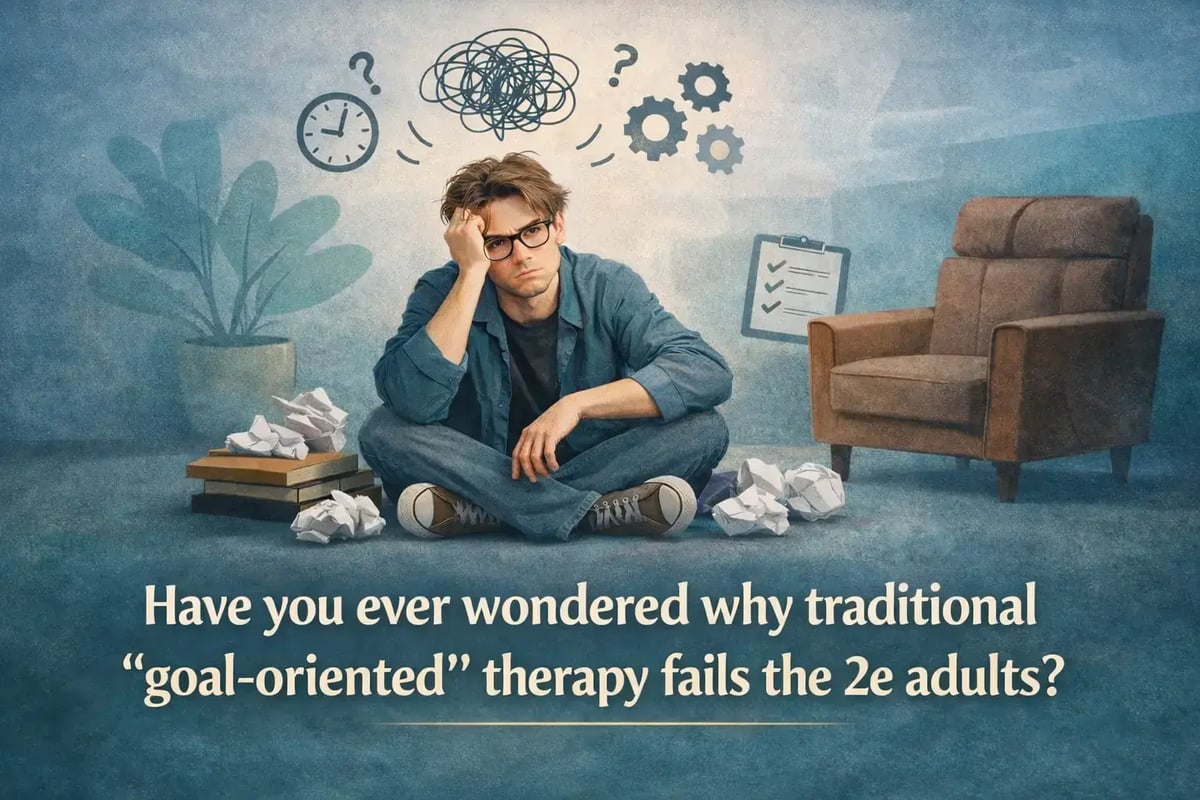
You may crave the structure of a solution, but your AuDHD brain might not agree with the structure that comes from Cognitive Behavioural Therapy (CBT).
But what about traditional talk therapy makes it unsuitable for your brain?
By: Michael Holker, MSW, RSW - Published March 2026 - Updated October 2026
Why Therapy for Gifted Adults Must Address the Hidden Struggles of 2e Adults
Twice exceptional adults often experience traditional talk therapy (CBT) as gaslighting. That’s because traditional therapy assumes that if you change your thoughts, your feelings, and behaviour will follow. For the gifted brain, this often backfires.
Here are some proven reasons why talk therapy doesn’t work well for gifted adults:
- You can logically dismantle a distorted thought, but because your physiological state hasn’t shifted, your brain will often generate a new story to explain lingering tension in the body.
- You are also smarter than the protocol, so you see what a therapist is doing during the session, which creates boredom and a loss of clinical trust.
- It’s also common for gifted adults to use their verbal intelligence to rationalize their pain away and talk in circles around their emotional wound.
- They invalidate pattern recognition and may tell you to stop catastrophizing because they may not understand your hyper-aware 2e brain.
|
Traditional Therapy Focus |
Why It Fails 2e Adults |
The Neuro-Affirming Alternative |
|
Behavioral Compliance |
Feels like “masking” or “performing.” |
Authentic Autonomy & self-advocacy. |
|
SMART Goals |
Too rigid, ignores sensory energy levels. |
Values-based energy management |
|
Social Skills training |
Teaches you to mimic neurotypicals. |
Double Empathy & finding “your people.” |
|
Cognitive Logic |
You’ve already “outthought” the logic |
Nervous System Regulation (Bottom-Up). |
If you're still working out what giftedness actually means in the context of neurodivergence, Is Giftedness Neurodivergent? Understanding the 2e Paradox unpacks the relationship between the two.
The 2e Paradox—When High Ability Meets High Support Needs
The Twice-Exceptional (2e) experience is a rollercoaster journey that often leaves you feeling misunderstood.
Therapists who aren’t trained in neurodivergence may misinterpret your experience and fail to offer the support your brain needs to feel safe.
Because the 2e brain processes information differently, it needs a different approach to healing. And that process begins with understanding the differences.
Part of what makes therapy so necessary for gifted adults is the cumulative weight of Tall Poppy Syndrome — Understanding Tall Poppy Syndrome explores how this social dynamic shapes gifted and neurodivergent adults from childhood onward.
Bottom-Up vs. Top-Down Healing
Twice exceptional and neurodivergent adults process things from the bottom up. What does that mean? It means that instead of looking at the concept of a problem or situation, we look at the details first.
For example, imagine you are a detective piecing together a crime. A 2e brain walks into the crime scene and is hit by 4,000 data points. Broken glass from the window, the hum of the refrigerator, and the tremble of the witness’s left hand.
The neurotypical brain sees the same scene and logically concludes it’s a classic smash-and-grab crime. They call for backup, log the evidence that supports their theory, and head to lunch at noon.
Neurodivergent brains zoom in on the details. You see, smell, hear, and feel everything that’s happening around you. So, using past experience to create a concept isn’t the way your brain works.
That’s why “talk therapy” Isn’t helpful. Your brain simply doesn’t benefit from that structure.
To find relief, your 2e brain needs to move from the “head” (analysis) down into the “body” (regulation).
In my practice and my experience as a 2e adult, I found a few techniques to be helpful.
- Interoceptive Awareness: Instead of analyzing your feelings, we work on interoception, which is the ability to feel and identify signals your body is sending you.
- State-Dependent Meaning-Making: Your brain is a storyteller that creates thoughts to match your body’s physiological state. We use Polyvagal-informed tools to shift you out of a sympathetic (agitated) or dorsal (shutdown) state, allowing your story to change naturally.
- Intent-based goal setting: Replacing rigid SMART goals with dopamine-friendly frameworks that honour the AuDHD need for variety and passion.
- Neuro-affirming frameworks: Instead of “fixing” your traits, you create frameworks that accommodate your biology to prevent chronic burnout.
- Deep Dive Exploration: The gifted adults I work with benefit greatly from complex, existential exploration over surface-level coping skills.
Gifted and AuDHD brains don’t think in straight lines—we think in webs. So, being told to just change your thoughts feels dismissive of a complex nervous system.
Searching for therapy for gifted adults near me often puts you in touch with generalists who don’t understand the nuances of your complex brain. But therapy for gifted adult in Ontario gives you a great chance of reducing burnout and overwhelm in your day-to-day life.
What does neuro-affirming therapy look like for gifted adults?
In neuro-affirming therapy, we move away from “fixing” and toward “understanding.” As your therapist, I know that you don’t need to be ‘fixed’, you need support. I also know how exhausting it can feel to mask your ADHD or autism symptoms and eventually end up in burnout.
So, we do things differently.
Every framework we use together, from CBT to Polyvagal theory, is adapted in collaboration with you to respect your unique 2e processing style and sensory needs.
I work with many 2e professionals and creatives in Ontario whose careers put them in constant high-pressure environments.
And I can assure you, it is possible to be yourself and reduce and navigate the pressures to mask in any environment.
Neuro-affirming therapy involves acceptance and accommodation for all your needs, and guidance on how to set boundaries in relationships and advocate for yourself.
You can expect the following in our sessions:
- Your sensory reality is validated and accommodated. Your sensory sensitivities aren’t “anxiety”; they are physical facts, and our sessions recognize that.
- Collaborative, not clinical, and no power dynamics. The only expert in our sessions is you. A neuro-affirming therapist is your consultant, not an authority figure who tells you what you’re experiencing.
- Focus on Accommodations over Skills. Instead of teaching you social skills, neuro-affirming therapy focuses on self-advocacy to help you avoid autistic burnout.
- Nervous system regulation is first. We use tools like stimming, movement, and even colouring to get you into a regulated state and out of fight or flight.
- A safe space. Above all, therapy is a safe space to unmask. You don’t have to sit still, maintain eye contact, or follow neurotypical rules for conversation. Be yourself and process the information we discuss; however, it feels best for YOU.
Much of what makes therapy transformative for 2e adults is the identity work underneath — The Role of Identity in Neurodivergent Healing explores what that layer looks like and why it matters so much for people who've spent years performing competence.
Moving Beyond Survival—Building a 2e Life That Fits
For many gifted and AuDHD adults in Ontario, life has felt like trying to force a high-performance jet to drive on a gravel road. You are exhausted, not because you are “broken”, but because you are over-functioning in an environment that wasn’t built for your sensory or intellectual RPMs.
Nowhere is that mismatch more visible than in a career you have mastered and quietly outgrown — the pattern we explore in gifted adults and meaningful work.
Neuro-affirming therapy isn’t just about managing symptoms; it’s about re-engineering your life to support your unique brain architecture.
From self-criticism to radical self-knowledge
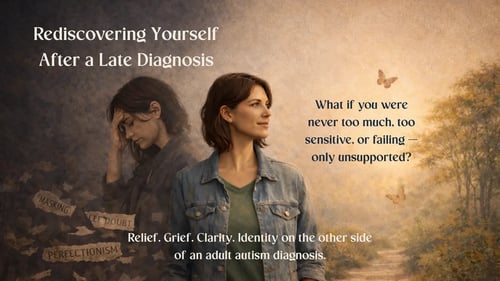
When you stop viewing your bottom-up processing as a problem to fix and begin healing the potential wound of your late diagnosis, you finally see your brain for what it is: a high-precision tool for pattern recognition and deep empathy.
Your complexity is your strength.
You don’t have to choose between being “smart” and being “well.” You deserve a therapeutic space where your intelligence is respected, your sensory needs are met, and your 2e paradox is understood without your having to explain it for the hundredth time.
Being understood without a hundred explanations matters more than it sounds — it is the antidote to what we have called the loneliness of being admired but not known.
If you are interested in therapy for gifted adults in Ontario that goes beyond the surface and dives deep into who you are I would be happy to chat.
Start Your Neuro-Affirming Journey
You’ve spent enough time analyzing your life from the outside. It’s time to work with a therapist who speaks your brain’s language.
Book a Free 20-minute Meet ‘n’ Greet
Many people who benefit from therapy that affirms neurodivergent minds. struggle with issues like asynchronous development, ADHD burnout, and sensory overload, which leads to trauma.
Frequently Asked Questions About Therapy for Neurodivergent Adults
I’ve tried traditional talk therapy, and it doesn’t help. How is this different?
Traditional talk therapy targets distorted thoughts. For a 2e brain, your thoughts are usually based on highly accurate pattern recognition and intense sensory data, so it’s important that we modify this modality to fit your brain.
Do I need a formal diagnosis of Autism or ADHD to work with you?
No. Many 2e adults in Ontario have spent a lifetime “masking” well enough to avoid a formal diagnosis, or their struggles were missed because of their high IQ. If you resonate with the 2e paradox and the Bottom-Up processing style, this space is for you.
Can you actually help with burnout, or is this just more talking?
We address the burnout by looking at your Energy Accounting. Because 2e burnout is often caused by “sensory and masking debt,” we don’t just talk about feelings.
Have a question I didn’t cover? Feel free to ask your most complex questions during our initial consultation.
References
Dabrowski, K. (1972). Psychoneurosis is not an illness: Neuroses and psychoneuroses from the perspective of positive disintegration. Gryf Publications.
Neihart, M. (1999). The impact of giftedness on psychological well-being: What does the empirical literature say? Roeper Review, 22(1), 10–17. https://doi.org/10.1080/02783199909553991
Piechowski, M. M. (1997). Emotional giftedness: The measure of intrapersonal intelligence. In N. Colangelo & G. A. Davis (Eds.), Handbook of gifted education (2nd ed., pp. 366–381). Allyn & Bacon.
Silverman, L. K. (2013). Giftedness 101. Springer Publishing Company.
Webb, J. T., Amend, E. R., Webb, N. E., Goerss, J., Beljan, P., & Olenchak, F. R. (2005). Misdiagnosis and dual diagnoses of gifted children and adults: ADHD, bipolar, OCD, Asperger’s, depression, and other disorders. Great Potential Press.
This article is for educational purposes only and is not a substitute for individualized therapy or medical advice. If you are in crisis, please contact emergency services or a crisis line in your area.
Michael Holker is a Registered Social Worker and neurodiversity-affirming therapist offering virtual therapy across Ontario for adults with ADHD, autism, AuDHD, giftedness, and twice-exceptionality. Learn more about working with Michael →
Blog Disclaimer
This blog may include occasional personal reflections or composite-style anecdotes to illustrate therapeutic ideas and foster connection. Any identifying details have been altered, omitted, or generalized to protect confidentiality. These examples are shared for educational purposes only. Every person’s experience is unique, and what resonates with one individual may not apply to another.
The content on this website is provided for educational and informational purposes only and is not a substitute for medical advice, mental health advice, diagnosis, or treatment. Reading this blog does not establish a therapist-client relationship. If you have concerns about your mental health, physical health, or overall well-being, please consult a qualified healthcare provider or licensed mental health professional.
Psychotherapy services described on this website are available to residents of Ontario, in accordance with applicable professional standards and the scope of practice. If you are interested in working together or would like to schedule a complimentary 20-minute consultation, you are welcome to contact me through my practice.
These resources are offered to support reflection, learning, and self-understanding as you move toward a more grounded, authentic, and meaningful life.

Michael Holker MSW, RSW
Mar 13, 2026, 10:00:00 AM
Mar 13, 2026, 10:00:00 AM
Michael Holker, MSW, RSW, is a Registered Social Worker and Psychotherapist who practices neurodiversity-affirming therapy and is the founder of Becoming Yourself Counselling and Consulting — a virtual practice based in Toronto that serves adults across Ontario. He works with late-diagnosed and self-identified autistic, ADHD, AuDHD and gifted (2e) adults, bringing lived experience of neurodivergence to a trauma-informed, strengths-based approach. He practises alongside Euodia Leung, MSW, RSW, whose focus is anxiety, depression and self-esteem. Book a free 20-minute meet-and-greet.