---
title: Diagnosed with Autism as an Adult? What Identity Looks Like After.
description: Have you received an adult autism diagnosis in Ontario? If so, learning what identity looks like on the other side requires support. Learn more here.
image: https://becomingyourself.com/hubfs/Rediscovering%20Yourself%20After%20a%20Late%20Diagnosis%20What%20Identity%20Looks%20Like%20on%20the%20Other%20SideV116-9.webp
---
[Skip to main content](https://becomingyourself.com/onbecomingyourself/what-identity-looks-like-after-late-diagnosis-of-autism#main-content)
[   ](https://becomingyourself.com)
- [Home](https://becomingyourself.com)
- [Services & Approach](https://becomingyourself.com/neurodiversity-affirming-therapy-ontario)
- [Our Team](https://becomingyourself.com/team)
- [Contact](https://becomingyourself.com/contact)
- [Blog](https://becomingyourself.com/onbecomingyourself)
Open main navigation
Close main navigation
- [Home](https://becomingyourself.com)
- [Services & Approach](https://becomingyourself.com/neurodiversity-affirming-therapy-ontario)
- [Our Team](https://becomingyourself.com/team)
- [Contact](https://becomingyourself.com/contact)
- [Blog](https://becomingyourself.com/onbecomingyourself)
- [FREE Meet & Greet](https://becomingyourself.janeapp.com/#/list)
[FREE Meet & Greet](https://becomingyourself.janeapp.com/#/list)
[Blog](https://becomingyourself.com/onbecomingyourself)
Tags
- [Autism](https://becomingyourself.com/onbecomingyourself/tag/autism)
- [neurodiversity-affirming therapy](https://becomingyourself.com/onbecomingyourself/tag/neurodiversity-affirming-therapy)
- [Identity and Self](https://becomingyourself.com/onbecomingyourself/tag/identity-and-self)
- [ADHD](https://becomingyourself.com/onbecomingyourself/tag/adhd)
- [Burnout and Masking](https://becomingyourself.com/onbecomingyourself/tag/burnout-and-masking)
- [AuDHD](https://becomingyourself.com/onbecomingyourself/tag/audhd)
- [Therapy for gifted adults](https://becomingyourself.com/onbecomingyourself/tag/therapy-for-gifted-adults)
Search
- [Autism](https://becomingyourself.com/onbecomingyourself/tag/autism)
- [neurodiversity-affirming therapy](https://becomingyourself.com/onbecomingyourself/tag/neurodiversity-affirming-therapy)
- [Identity and Self](https://becomingyourself.com/onbecomingyourself/tag/identity-and-self)
- [ADHD](https://becomingyourself.com/onbecomingyourself/tag/adhd)
- [Burnout and Masking](https://becomingyourself.com/onbecomingyourself/tag/burnout-and-masking)
- [AuDHD](https://becomingyourself.com/onbecomingyourself/tag/audhd)
- [Therapy for gifted adults](https://becomingyourself.com/onbecomingyourself/tag/therapy-for-gifted-adults)
[Autism](https://becomingyourself.com/onbecomingyourself/tag/autism) [Late Diagnosis](https://becomingyourself.com/onbecomingyourself/tag/late-diagnosis) [Identity and Self](https://becomingyourself.com/onbecomingyourself/tag/identity-and-self)
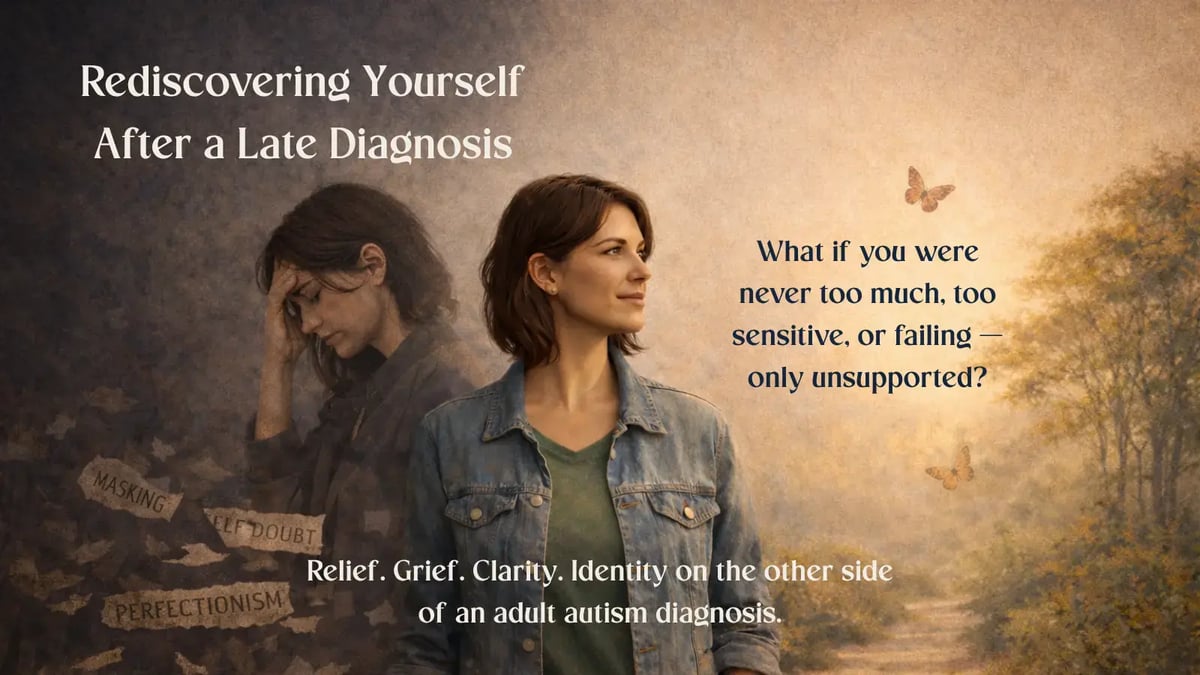
# Rediscovering Yourself After a Late Diagnosis: What Identity Looks Like on the Other Side
*By Michael Holker BSW, MSW, Registered Social Worker | Psychotherapist | Published: July 2026*
*This article is for educational purposes only and is not a substitute for individualized therapy or medical advice. If you are in crisis, please contact emergency services or a crisis line in your area.*
It happens. You are finally diagnosed or self-identify with autism as an adult, or you've read enough to feel strongly that autism fits your internal world. Now what? Perhaps your initial response was relief, perhaps a bit confused, maybe even angry or sad about what's happened that's contributed to where you are.
Many adults who have been diagnosed with autism spectrum disorder seek out[**autism therapy in Ontario**](https://becomingyourself.com/autism-therapy-for-adults-in-ontario)to help clarify where they are and how to support themselves.
That's a natural desire after years of feeling almost like an outsider in your own life. Identity after a late autism diagnosis in adults looks different for everyone, but in this article, we are going to explore what your identity might look like after your diagnosis.
## What It Can Feel Like to Be Diagnosed with Autism as an Adult
After being diagnosed with autism, adult life may feel different. You could feel both relief and grief at the same time. Relief often comes from finally understanding why life has felt harder, stranger, or more exhausting than it seemed for others.
Grief often comes from realizing how long you lived without the right language, support, or recognition for what you experience.
Others feel anger when reflecting on years of invalidation, misunderstanding, or self-blame.
### Relief is Real
After a lifetime of undiagnosed autism, you may feel a strong sense of relief from having a name for what you've felt. Most individuals experience a noticeable reduction in shame and confusion. What you have been shamed for or rejected for is now understood by you, who is the most important person to understand what's happening.
### Grief is Real
The pain of looking back on missed support, misinterpretations, or lost time in your life is also real. Grief doesn't make your late-in-life autism diagnosis bad. It means the experience you had matters.
### Why Both Emotions Can Exist at Once
Your diagnosis can be grounding and destabilizing at the same time. It sounds strange, but it is a real experience many adults with autism have. You now have the language for lifelong difference. All along the way, your masking, burnout, sensitivity, and underachievement, or feeling too much, now make sense.
Late diagnosis can bring a painful reappraisal of the past, which leads to a grieving process. You weren't lazy, inconsistent, immature, or a failure; you were neurodivergent and under extreme nervous system strain. Your needs were very likely not being met, and your differences weren't supported.
Holding relief and grief together is the part almost nobody warns you about — the [relief and grief of a late AuDHD diagnosis](https://becomingyourself.com/onbecomingyourself/understanding-adhd-autism-journey) sits with that particular mix rather than trying to resolve it.
## How Late Diagnosis Changes the Story You Tell About Your Past
School, work, friendships, and family relationships may suddenly make more sense. Your burnout and underachievement may also make more sense. We write more about that relational side in [ADHD, autism and relationships](https://becomingyourself.com/onbecomingyourself/adhd-autism-relationships-connection-difficult).
Maybe your relationships have been strained by your unique communication style, or your struggle with overstimulation has impacted your career. Perhaps burnout has affected your friendships, making it difficult for friends to understand what was happening when you couldn't make it to a social event.
Now you can look at these experiences through the lens of unsupported neurodivergence rather than personal failure. You're in many ways rewriting your history.
### Reframing Old Labels
With a late-in-life adult diagnosis, you may have learned labels like:
- Laziness
- Immaturity
- Inconsistency
- Overreaction
Maybe you have a diagnosable explanation—you are neurodivergent. A diagnosis challenges those labels and helps you see what is causing your reactions and struggles.
### The Past Often Looks Different After Diagnosis
Masking, sensory strain, social exhaustion, shutdowns, and burnout now have a new framework. Instead of failures or weaknesses, these are now seen as patterns that naturally occur with neurodivergence, which is undiagnosed and misunderstood.
## Identity After Diagnosis is Rarely Simple
Immediate clarity after your diagnosis is unlikely and not simple. In fact, for many clients, it can bring up the question, "Who am I underneath coping, masking, perfectionism, people-pleasing, and self-criticism?"
Diagnosis is important, but it can disrupt identities built around performance, survival, or fitting in. That's where a neuro-affirming therapist can prove helpful. We work with neurodivergent adults who are working through the emotions that surface after a late-in-life autism or neurodivergent diagnosis.
### The Difference Between Authentic Traits and Survival Strategies
Some habits were adaptations, not your core self. You were coping with a world that didn't support you or your nervous system. So now the work is realizing your authentic traits and who you really are.
Rediscovery often involves separating your survival strategies from your authentic traits and [understanding how identity continues to evolve in the healing process.](https://becomingyourself.com/onbecomingyourself/the-role-of-identity-in-neurodivergent-healing)
### Why Masking Can Make Identity Harder to Find
Long-term masking can blur self-perception. When you're performing who you're not, you may feel lost beneath the noise of it all. You may also feel exhausted by who you've had to become to survive. Our work in neuro-affirming therapy is to identify that you've spent years performing versions of yourself that felt safer or more acceptable, and recognize that you don't have to continue on that way.
## Common Patterns That Start to Make Sense After an Adult Diagnosis of Autism Spectrum Disorder
Not sure which of your life patterns might be related to your adult diagnosis of autism spectrum disorder? Here are a few patterns I've noticed in my own practice that may sound familiar to you.
Do you feel:
- Chronic overwhelm?
- Social exhaustion?
- Intense interests?
- Emotional intensity?
- Executive functioning struggles?
- Sensory sensitivities?
- Uneven performance?
- Trouble maintaining conventional routines?
If so, you've likely felt or experienced the fallout of neurodivergent burnout. These patterns aren't random and aren't shameful. They are simply your lived experience as you try to manage life as a neurodivergent individual.
### Why do many adults miss the pattern
Your neurodivergence may have been masked by high performance, intelligence, gendered expectations, or even by being high-achieving on the outside. It's possible that your adult autism diagnosis was hidden because of your capabilities. You aren't wrong for not noticing it until now.
## The Strengths That Often Come Into Focus After Diagnosis
A diagnosis not only explains the pain you feel, but it can also help you name strengths that were never properly recognized. For example, many of my clients start to recognize they have strengths and good qualities that are a direct result of autism.
**Qualities like:**
- Deep empathy
- Creativity
- Pattern recognition
- Originality
- Moral sensitivity
- Persistence
- Intuition
- Humor
- Intense care
For example, maybe your intensity, sensitivity, or focus was treated as a problem rather than an asset. Your intensity could be used to be better at your job, or maybe your intuition helps you be a better problem solver.
These skills are nuanced, which means they can be strengths if we let them.
### Why Strengths Matter for Identity Repair
Once you understand the fuller story of who you are and your experiences, you will begin to trust yourself more and feel more dignity in who you are.
In therapy, we don't see this process as fixing you, but rather as coming home to yourself.
Rediscovering yourself could mean giving up old standards rooted in comparison and beginning to ask, What is true for me? What helps me thrive? What kind of life fits my nervous system, values, and mind?
Your diagnosis could be an invitation to build a more compassionate relationship with yourself, especially if shame has shaped your story.
Healing isn't always about learning new skills or symptom management. It can also be about rebuilding your identity with dignity, clarity, and self-trust.
A supportive neurodivergent-affirming therapist can help you integrate your diagnosis into a fuller sense of self. Instead of just putting a label on your experience, we'll look to help you understand how your neurotype has shaped your story.
## Mourning the Self You Thought You Had to Be
One of the greatest causes of sorrow for late-diagnosed autistic adults is letting go of comparison-based standards. Comparing the way you've operated throughout your life with how neurotypical people operate isn't fair. Mourning the thought of who you thought you had to be is a big part of healing. It is not a detour from the healing path.
### Letting Go of Old Standards
Standards around social norms, sensory acceptance, or performance metrics must be released for you to heal fully. Instead of rejecting the way your brain works, you'll learn how to accept it. Self-acceptance is the most powerful force for healing a lifetime of feeling misunderstood.
## Why Self-Acceptance Is Part of Identity Repair
Accepting yourself isn't resignation. It looks like learning what support you need, what environments fulfill you, what drains you, and what helps you regulate. That looks different for everyone.
Self-acceptance even changes the questions you ask to feel better. Instead of asking, "What is wrong with me?" you begin asking, "What is true for me?"
This shifts the decisions you make about work, relationships, when you rest, and what support you seek out.
Part of that support may include learning [**how to choose a neurodivergent-affirming therapist**,](https://becomingyourself.com/onbecomingyourself/choose-neurodivergent-affirming-therapist) especially if you want therapy that understands masking, late diagnosis, identity repair, sensory needs, and the difference between authentic growth and correction.
Speaking of support, the right supportive therapy can help you integrate your neurodivergent diagnosis into a fuller sense of self.
## Rediscovering Yourself on the Other Side of Diagnosis
The question you may have is, what does your life look like on the other side of diagnosis? Your identity on the other side of your diagnosis is often less about fixing yourself and more about coming home to yourself. You begin to feel qualities such as dignity, clarity, self-compassion, greater authenticity, and, above all, self-trust.
This is also where [**neurodiversity-affirming therapy services in Ontario**](https://becomingyourself.com/neurodiversity-affirming-therapy-ontario)can help, by supporting self-understanding, unmasking, emotional regulation, and a more compassionate relationship with your neurodivergent identity.
### Becoming Yourself, Not Who the World Demanded
For neurodivergent adults, life has many exhausting demands that make it hard to thrive. However, as you begin to accept yourself and your diagnosis, you start becoming yourself. You no longer feel burnt out because you recognize you need and have created an environment that supports them.
Your experiences are valid. Now you have the language for what you've experienced. Next, you can begin to live a life that feels like your own, not what the world has told you you had to become.
Understanding who you are after a late diagnosis opens a door — [Neurodivergent Self-Actualization](https://becomingyourself.com/onbecomingyourself/neurodivergent-self-actualization) explores what it looks like to build a life from that new understanding outward.
## Conclusion
Being diagnosed with autism as an adult can be painful, clarifying, and deeply meaningful. The process of rediscovery is not always neat. However, it can help you build a more compassionate and accurate relationship with them.
Diagnosis offers language, permission, and a perspective that allows you to rediscover the self that was there all along.
Working through a late diagnosis takes time. If you're ready to start your path to becoming yourself, [book a free 20-minute meet-and-greet](https://becomingyourself.janeapp.com) with me. I would love to see if I am the right fit for your journey.
### Frequently Asked Questions
#### Is it normal to feel both relief and grief after a late autism diagnosis?
Yes. Relief and grief very commonly arrive together — relief at finally having language for why life felt harder, grief for how long you went without the right support. Anger is common too. Feeling all of this at once does not mean the diagnosis was wrong. It means what you lived through mattered.
#### Why does a late autism diagnosis cause an identity crisis?
A late diagnosis can unsettle identity because so much of who you became was built around coping — masking, perfectionism, people-pleasing, performing a version of yourself that felt safer. When the explanation changes, the story of your past changes with it, and it is natural to ask who you are underneath the strategies. This is less a crisis than a reorganization. We explore it more fully in [the role of identity in neurodivergent healing](https://becomingyourself.com/onbecomingyourself/the-role-of-identity-in-neurodivergent-healing).
#### Can a late autism diagnosis lead to depression?
A late diagnosis does not cause depression, but the period afterward can bring low mood, grief, and a painful re-examination of the past. Research on late-diagnosed adults describes both outcomes: many report greater self-understanding and self-compassion over time, while others struggle, particularly without support or community. If low mood persists or starts to feel unmanageable, it is worth reaching out to a qualified professional. If you are in crisis, please contact emergency services or a crisis line in your area.
#### Is late-diagnosed autism real? Why wasn’t it noticed earlier?
Yes, late-diagnosed autism is real. Autism is present from early life; what arrives late is the recognition. Many adults were missed because their traits were masked by intelligence, high performance, or gendered expectations, or because the people around them only knew a narrow picture of what autism looks like. Often the pattern becomes visible only when [masking leads to burnout](https://becomingyourself.com/onbecomingyourself/masking-burnout-in-toronto-recovery-guide) and the old strategies stop working. Not noticing until now is not a failure on your part.
#### How do I start unmasking after a late autism diagnosis?
Unmasking usually begins slowly, and with safety. A helpful first step is noticing the difference between authentic traits and survival strategies: what drains you, what regulates you, and what you do only because it once kept you safe. Many people begin in low-risk places — alone, with one trusted person, or in therapy — rather than everywhere at once. Masking developed for good reasons, and it is okay to keep it where you still need it. [Neurodivergent self-actualization](https://becomingyourself.com/onbecomingyourself/neurodivergent-self-actualization) looks at what building outward from there can involve.
#### Do I need a formal diagnosis, or is self-identification valid?
Self-identification is widely accepted within the autistic community, and recent research recognizes that many autistic adults lack a clinical diagnosis because assessment is costly, hard to access, or was shaped by clinicians who missed masked presentations. A formal diagnosis can matter for workplace accommodations or certain supports, so the choice depends on what you need. You do not need a diagnosis to begin [autism therapy with us in Ontario](https://becomingyourself.com/autism-therapy-for-adults-in-ontario).
#### How long does it take to adjust to a late autism diagnosis?
There is no set timeline for adjusting to a late diagnosis. For many adults, integration unfolds over months or years and moves in waves — relief, grief, anger, and clarity can each return more than once. This is not a sign of being stuck. It reflects how much there is to re-understand: school, work, relationships, and the labels you were given along the way. If burnout is part of the picture, [neurodivergent burnout recovery](https://becomingyourself.com/onbecomingyourself/neurodivergent-burnout-recovery-in-ontario) often needs to come first.
#### What kind of therapy helps after a late autism diagnosis?
Many adults find it most helpful to work with a therapist who understands masking, identity repair and sensory needs. Neurodiversity-affirming therapy does not treat autism as something to fix; it supports self-understanding, unmasking at your own pace, and a more compassionate relationship with your own history.
## References
Alaghband-rad, J., Hajikarim-Hamedani, A., & Motamed, M. (2023). Camouflage and masking behavior in adult autism. *Frontiers in Psychiatry, 14*, 1108110. [https://doi.org/10.3389/fpsyt.2023.1108110](https://doi.org/10.3389/fpsyt.2023.1108110)
Ardeleanu, K., Steinberg, H., Garfield, T., Voltaire, S., Shea, L., Brown, M., Chvasta, K., & Do Tan, C. (2025). Self-identification of autism: Why some autistic adults lack a clinical diagnosis and why this matters for inclusion. *Autism, 29*(9), 2344–2355. [https://doi.org/10.1177/13623613241297222](https://doi.org/10.1177/13623613241297222)
Corden, K., Brewer, R., & Cage, E. (2021). Personal identity after an autism diagnosis: Relationships with self-esteem, mental wellbeing, and diagnostic timing. *Frontiers in Psychology, 12*, 699335. [https://doi.org/10.3389/fpsyg.2021.699335](https://doi.org/10.3389/fpsyg.2021.699335)
Gray, S. M., McMorris, C. A., Mudry, T., & McCrimmon, A. W. (2024). An exploration of diagnostic identity for autistic individuals: A systematic review of existing literature. *Research in Autism Spectrum Disorders, 114*, 102394. [https://doi.org/10.1016/j.rasd.2024.102394](https://doi.org/10.1016/j.rasd.2024.102394)
Perry, E., Mandy, W., Hull, L., & Cage, E. (2022). Understanding camouflaging as a response to autism-related stigma: A social identity theory approach. *Journal of Autism and Developmental Disorders, 52*(2), 800–810. [https://doi.org/10.1007/s10803-021-04987-w](https://doi.org/10.1007/s10803-021-04987-w)
*This article is for educational purposes only and is not a substitute for individualized therapy or medical advice. If you are in crisis, please contact emergency services or a crisis line in your area.*
## Blog Disclaimer
This blog may include occasional personal reflections or composite-style anecdotes to illustrate therapeutic ideas and foster connection. Any identifying details have been altered, omitted, or generalized to protect confidentiality. These examples are shared for educational purposes only. Every person’s experience is unique, and what resonates with one individual may not apply to another.
The content on this website is provided for educational and informational purposes only and is not a substitute for medical advice, mental health advice, diagnosis, or treatment. Reading this blog does not establish a therapist-client relationship. If you have concerns about your mental health, physical health, or overall well-being, please consult a qualified healthcare provider or licensed mental health professional.
Psychotherapy services described on this website are available to residents of Ontario, in accordance with applicable professional standards and the scope of practice. If you are interested in working together or would like to schedule a complimentary 20-minute consultation, you are welcome to contact me through my practice.
These resources are offered to support reflection, learning, and self-understanding as you move toward a more grounded, authentic, and meaningful life.
Tags:
[Autism](https://becomingyourself.com/onbecomingyourself/tag/autism) [Late Diagnosis](https://becomingyourself.com/onbecomingyourself/tag/late-diagnosis) [Identity and Self](https://becomingyourself.com/onbecomingyourself/tag/identity-and-self)

**[Michael Holker BSW, MSW Registered Social Worker | Psychotherapist](https://becomingyourself.com/onbecomingyourself/author/michael-holker-hba-bsw-msw-rsw)**
Apr 10, 2026, 4:00:00 PM
Michael Holker, MSW, RSW, is a Registered Social Worker and neurodiversity-affirming psychotherapist, and the founder of Becoming Yourself Counselling and Consulting — a virtual practice based in Toronto that serves adults across Ontario. He works with late-diagnosed and self-identified autistic, ADHD, AuDHD and gifted (2e) adults, bringing lived experience of neurodivergence to a trauma-informed, strengths-based approach. He practises alongside Euodia Leung, MSW, RSW, whose focus is anxiety, depression and self-esteem. Book a free 20-minute meet-and-greet.
[Follow me on my website](https://becomingyourself.com) [Follow me on Facebook](https://www.facebook.com/BecomingYourslf) [Follow me on LinkedIn](https://www.linkedin.com/in/michael-holker-09986093/)
## Related Articles
[ Neurodivergent Burnout Recovery: What It Actually Takes to Heal — and What Gets in the Way Michael Holker BSW, MSW Registered Social Worker | Psychotherapist • Aug 15, 2026, 9:00:00 AM](https://becomingyourself.com/onbecomingyourself/neurodivergent-burnout-recovery-in-ontario)
[ Sensory Overload in Neurodivergent Adults: What Is Actually Happening and How to Find Relief in Ontario Michael Holker BSW, MSW Registered Social Worker | Psychotherapist • Jul 31, 2026, 9:00:00 AM](https://becomingyourself.com/onbecomingyourself/sensory-overwhelm-in-ontario)
[ When You Can't Stop Performing: Masking Burnout for Neurodivergent Professionals in Toronto's Financial District Michael Holker BSW, MSW Registered Social Worker | Psychotherapist • Jul 15, 2026, 9:00:05 AM](https://becomingyourself.com/onbecomingyourself/masking-burnout-in-toronto-recovery-guide)
[](https://becomingyourself.com/hubfs/BecomingYourselSolidColoursNoWordingTransparent-2.png)
1108 - 250 Consumers Rd. #413
North York, ON M2J4V6
(For Mailing Purposes Only)
Becoming Yourself Counselling and Consulting provides neurodiversity-affirming online therapy for adults across Ontario.
Virtual Counselling is available across Ontario, including Toronto, Ottawa, Hamilton, London, Kitchener-Waterloo, Mississauga, and beyond.
**THERAPY FOR:**
[ADHD](https://becomingyourself.com/adhd-therapy-for-adults-in-ontario)
[AUTISM](https://becomingyourself.com/autism-therapy-for-adults-in-ontario)
[AuDHD](https://becomingyourself.com/audhd-therapy-in-ontario)
[Gifted & Neurodivergent (2e)](https://becomingyourself.com/therapy-for-gifted-adults-in-ontario)
**DISCOVER:**
[Home](https://becomingyourself.com)
[Services & Approach](https://becomingyourself.com/neurodiversity-affirming-therapy-ontario)
[Our Team](https://becomingyourself.com/team)
[Contact](https://becomingyourself.com/contact)
[On Becoming Yourself Blog](https://becomingyourself.com/onbecomingyourself)
© 2026 Becoming Yourself Counselling and Consulting. All rights reserved.
[Privacy Policy](https://becomingyourself.com/privacy) [Website Terms of Use](https://becomingyourself.com/website-terms-of-use)
```json
{
"@context" : "https://schema.org",
"@type" : "BlogPosting",
"author" : {
"@type" : "Person",
"name" : "Michael Holker BSW, MSW Registered Social Worker | Psychotherapist",
"url" : "https://becomingyourself.com/onbecomingyourself/author/michael-holker-hba-bsw-msw-rsw"
},
"dateModified" : "2026-10-01T15:44:20.029Z",
"datePublished" : "2026-04-10T20:00:00.000Z",
"headline" : "Diagnosed with Autism as an Adult? What Identity Looks Like After.",
"image" : [ "https://becomingyourself.com/hubfs/Rediscovering%20Yourself%20After%20a%20Late%20Diagnosis%20What%20Identity%20Looks%20Like%20on%20the%20Other%20SideV116-9.webp" ],
"mainEntityOfPage" : {
"@id" : "https://becomingyourself.com/onbecomingyourself/what-identity-looks-like-after-late-diagnosis-of-autism",
"@type" : "WebPage"
},
"publisher" : {
"@type" : "Organization",
"logo" : {
"@type" : "ImageObject",
"url" : "https://becomingyourself.com/hubfs/BecomingYourselSolidColoursNoWordingTransparent-1.png"
},
"name" : "Becoming Yourself Counselling"
}
}
```
```json
{
"@context" : "https://schema.org",
"@id" : "https://becomingyourself.com/#website",
"@type" : "WebSite",
"inLanguage" : "en-CA",
"name" : "Becoming Yourself Counselling and Consulting",
"publisher" : {
"@id" : "https://becomingyourself.com/#org"
},
"url" : "https://becomingyourself.com/"
}
```
```json
{
"@context" : "https://schema.org",
"@id" : "https://becomingyourself.com/#org",
"@type" : [ "Organization", "ProfessionalService" ],
"address" : {
"@type" : "PostalAddress",
"addressCountry" : "CA",
"addressLocality" : "North York",
"addressRegion" : "ON",
"postalCode" : "M2J 4V6",
"streetAddress" : "1108 - 250 Consumers Road #413"
},
"alternateName" : [ "Becoming Yourself Counselling", "Becoming Yourself Counselling & Consulting" ],
"areaServed" : [ {
"@type" : "AdministrativeArea",
"containsPlace" : [ {
"@type" : "City",
"name" : "Toronto"
}, {
"@type" : "City",
"name" : "Ottawa"
}, {
"@type" : "City",
"name" : "Mississauga"
}, {
"@type" : "City",
"name" : "Brampton"
}, {
"@type" : "City",
"name" : "Hamilton"
}, {
"@type" : "City",
"name" : "London"
}, {
"@type" : "City",
"name" : "Kitchener"
}, {
"@type" : "City",
"name" : "Waterloo"
}, {
"@type" : "City",
"name" : "Windsor"
}, {
"@type" : "City",
"name" : "Kingston"
} ],
"name" : "Ontario"
} ],
"contactPoint" : {
"@type" : "ContactPoint",
"areaServed" : "CA-ON",
"availableLanguage" : [ "en" ],
"contactType" : "customer support",
"email" : "michael@becomingyourself.com",
"telephone" : "+1-289-278-6272"
},
"description" : "Becoming Yourself Counselling and Consulting is a neurodiversity-affirming virtual therapy practice serving adults across Ontario through Registered Social Workers Michael Holker and Euodia Leung. Michael focuses on late-diagnosed and self-identified ADHD, autistic, AuDHD and gifted (2e) adults; Euodia supports neurodivergence, anxiety, depression, self-esteem, students, life transitions and adults exploring neurodivergence.",
"email" : "michael@becomingyourself.com",
"employee" : [ {
"@id" : "https://becomingyourself.com/michael-holker#person"
}, {
"@id" : "https://becomingyourself.com/euodia-leung#person"
} ],
"founder" : {
"@id" : "https://becomingyourself.com/michael-holker#person"
},
"geo" : {
"@type" : "GeoCoordinates",
"latitude" : 43.7785,
"longitude" : -79.3402
},
"legalName" : "Becoming Yourself Counselling and Consulting Services",
"logo" : {
"@type" : "ImageObject",
"url" : "https://becomingyourself.com/hubfs/Becoming%20Yourself%20Logo%20-%20Secondary.svg"
},
"name" : "Becoming Yourself Counselling and Consulting",
"openingHoursSpecification" : [ {
"@type" : "OpeningHoursSpecification",
"closes" : "18:00",
"dayOfWeek" : [ "Monday", "Tuesday", "Wednesday", "Thursday" ],
"opens" : "09:00"
} ],
"priceRange" : "$175+",
"sameAs" : [ "https://www.instagram.com/becomingyourselfcounselling/", "https://www.facebook.com/BecomingYourslf", "https://www.linkedin.com/in/michael-holker-09986093", "https://www.psychologytoday.com/ca/therapists/michael-holker-north-york-on/1057652", "https://www.psychologytoday.com/ca/therapists/euodia-leung-north-york-on/1833889", "https://maps.app.goo.gl/umd7FB9jUjUcrwhT7" ],
"telephone" : "+1-289-278-6272",
"url" : "https://becomingyourself.com/"
}
```
```json
{
"@context" : "https://schema.org",
"@id" : "https://becomingyourself.com/onbecomingyourself/what-identity-looks-like-after-late-diagnosis-of-autism#faq",
"@type" : "FAQPage",
"mainEntity" : [ {
"@type" : "Question",
"acceptedAnswer" : {
"@type" : "Answer",
"text" : "Yes. Relief and grief very commonly arrive together — relief at finally having language for why life felt harder, grief for how long you went without the right support. Anger is common too. Feeling all of this at once does not mean the diagnosis was wrong. It means what you lived through mattered."
},
"name" : "Is it normal to feel both relief and grief after a late autism diagnosis?"
}, {
"@type" : "Question",
"acceptedAnswer" : {
"@type" : "Answer",
"text" : "A late diagnosis can unsettle identity because so much of who you became was built around coping — masking, perfectionism, people-pleasing, performing a version of yourself that felt safer. When the explanation changes, the story of your past changes with it, and it is natural to ask who you are underneath the strategies. This is less a crisis than a reorganization. We explore it more fully in the role of identity in neurodivergent healing."
},
"name" : "Why does a late autism diagnosis cause an identity crisis?"
}, {
"@type" : "Question",
"acceptedAnswer" : {
"@type" : "Answer",
"text" : "A late diagnosis does not cause depression, but the period afterward can bring low mood, grief, and a painful re-examination of the past. Research on late-diagnosed adults describes both outcomes: many report greater self-understanding and self-compassion over time, while others struggle, particularly without support or community. If low mood persists or starts to feel unmanageable, it is worth reaching out to a qualified professional. If you are in crisis, please contact emergency services or a crisis line in your area."
},
"name" : "Can a late autism diagnosis lead to depression?"
}, {
"@type" : "Question",
"acceptedAnswer" : {
"@type" : "Answer",
"text" : "Yes, late-diagnosed autism is real. Autism is present from early life; what arrives late is the recognition. Many adults were missed because their traits were masked by intelligence, high performance, or gendered expectations, or because the people around them only knew a narrow picture of what autism looks like. Often the pattern becomes visible only when masking leads to burnout and the old strategies stop working. Not noticing until now is not a failure on your part."
},
"name" : "Is late-diagnosed autism real? Why wasn’t it noticed earlier?"
}, {
"@type" : "Question",
"acceptedAnswer" : {
"@type" : "Answer",
"text" : "Unmasking usually begins slowly, and with safety. A helpful first step is noticing the difference between authentic traits and survival strategies: what drains you, what regulates you, and what you do only because it once kept you safe. Many people begin in low-risk places — alone, with one trusted person, or in therapy — rather than everywhere at once. Masking developed for good reasons, and it is okay to keep it where you still need it. Neurodivergent self-actualization looks at what building outward from there can involve."
},
"name" : "How do I start unmasking after a late autism diagnosis?"
}, {
"@type" : "Question",
"acceptedAnswer" : {
"@type" : "Answer",
"text" : "Self-identification is widely accepted within the autistic community, and recent research recognizes that many autistic adults lack a clinical diagnosis because assessment is costly, hard to access, or was shaped by clinicians who missed masked presentations. A formal diagnosis can matter for workplace accommodations or certain supports, so the choice depends on what you need. You do not need a diagnosis to begin autism therapy with us in Ontario."
},
"name" : "Do I need a formal diagnosis, or is self-identification valid?"
}, {
"@type" : "Question",
"acceptedAnswer" : {
"@type" : "Answer",
"text" : "There is no set timeline for adjusting to a late diagnosis. For many adults, integration unfolds over months or years and moves in waves — relief, grief, anger, and clarity can each return more than once. This is not a sign of being stuck. It reflects how much there is to re-understand: school, work, relationships, and the labels you were given along the way. If burnout is part of the picture, neurodivergent burnout recovery often needs to come first."
},
"name" : "How long does it take to adjust to a late autism diagnosis?"
}, {
"@type" : "Question",
"acceptedAnswer" : {
"@type" : "Answer",
"text" : "Many adults find it most helpful to work with a therapist who understands masking, identity repair and sensory needs. Neurodiversity-affirming therapy does not treat autism as something to fix; it supports self-understanding, unmasking at your own pace, and a more compassionate relationship with your own history."
},
"name" : "What kind of therapy helps after a late autism diagnosis?"
} ]
}
```
```json
{
"@context" : "https://schema.org",
"@type" : "BreadcrumbList",
"itemListElement" : [ {
"@type" : "ListItem",
"item" : "https://becomingyourself.com/",
"name" : "Home",
"position" : 1
}, {
"@type" : "ListItem",
"item" : "https://becomingyourself.com/onbecomingyourself/",
"name" : "Blog",
"position" : 2
}, {
"@type" : "ListItem",
"item" : "https://becomingyourself.com/onbecomingyourself/what-identity-looks-like-after-late-diagnosis-of-autism",
"name" : "What Identity Looks Like After Late Diagnosis of Autism",
"position" : 3
} ]
}
```